
Before the Barrel
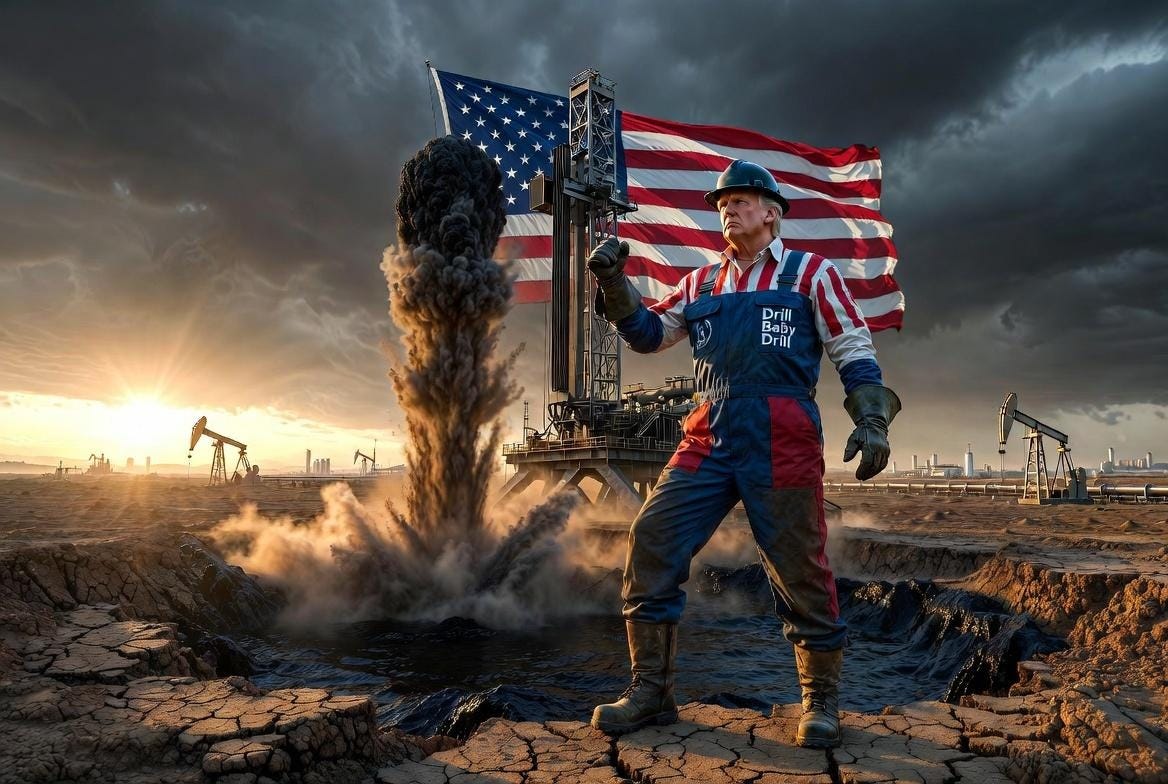
No barrel flows until someone else's rig, sand and crew show up first — energy's picks-and-shovels, paid before the first drop

The Week That It Was…
The third full week of Q3 arrived with the deceptive calm of a summer afternoon before a thunderstorm: the ECB confirmed with great solemnity that rates depend on data, data is uncertain, and the outlook requires monitoring — a press conference so reliably scripted it could have been pre-recorded in 2019. The earnings parade delivered its own war-cycle verdict: Tesla revealed whether Elon’s political adventures had finally dented his car sales; Alphabet confirmed whether Google was building the future or merely financing it at a loss; Northrop Grumman, Lockheed Martin, and RTX confirmed that bombs remain profitable; Halliburton and SLB provided the oil services read-through; Freeport McMoran delivered the copper verdict on global infrastructure; and Intel reminded everyone why semiconductors are simultaneously the most important and most humbling industry on the planet.
In a breathtaking display of American democratic meritocracy, the Manipulator-in-Chief has personally visited Darline Graham Nordone in the Oval Office and publicly implored her to run for her late brother’s Senate seat on a permanent basis — writing on Truth Social that “there would be nobody better to honour the legacy of her beloved brother” and demanding she “RUN, DARLINE, RUN” — a recruitment pitch delivered on behalf of a woman whose political résumé consists of a communications role at the South Carolina Vocational Rehabilitation Department and a seat on the Commission for the Blind, neither of which traditionally serves as a springboard to the world’s most exclusive legislative chamber. Following Lord Lindsey’s passing, Darline, Duchess of Charleston, ascended the High Chamber: crowned Baroness of the Palmetto Seat. Her brother’s fiefdom and noble lineage are preserved. The military-industrial complex and pro-Israel lobby are reportedly enthusiastic about her candidacy — because nothing says “effective Senate hawk” like inheriting a warmongering portfolio from a deceased sibling via presidential social-media post with less than a month until the primary. The Nepotic Republic of America has resolved a Senate vacancy the old-fashioned way: family name, Oval Office endorsement, and a Truth Social post — experience optional, bloodline mandatory

Newly declassified White House documents allege that intelligence officials obtained evidence of Chinese actors acquiring approximately 220 million American voter records — then softened, omitted, or destroyed the relevant reports rather than briefing elected officials, with documents later reportedly recovered from burn bags designated for classified destruction, because nothing says “protecting democracy“ quite like shredding the evidence that democracy was compromised. The double standard writes itself: had a Republican administration concealed intelligence showing a geopolitical adversary had acquired the voter data of 220 million Americans, the institutional response would have been considerably less patient — yet the same media apparatus that spent four years treating every Donald Copperfield’s tweet as an existential threat to democratic norms has approached this allegation with the measured restraint of institutions evaluating information that implicates their preferred political narrative. The broader pattern is numbingly familiar: deny, classify, delay, attack the messenger, and wait for public attention to migrate — a cycle so reliably repeated across every Washington scandal that it now qualifies as institutional standard operating procedure rather than exceptional misconduct.
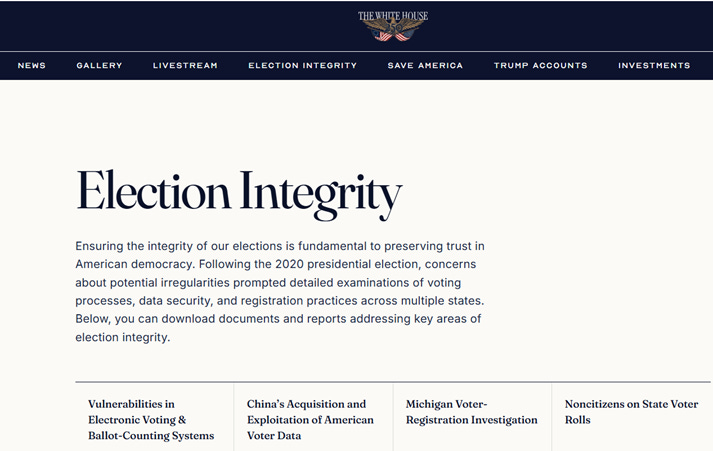
While Washington is currently conducting investigations into foreign electoral influence with strikingly asymmetric levels of institutional alarm: the newly declassified White House documents allege China secretly acquired 220 million American voter records and had intelligence reports softened or destroyed to conceal it — a scandal treated with the measured restraint of institutions evaluating inconvenient allegations —AIPAC, the single largest PAC in the 2026 election cycle, has openly spent $28 million across congressional campaigns, operates shell PACs with names like “Elect Chicago Women” and “Affordable Chicago Now,” routes money through organisations targeting candidates who want to condition military aid — all entirely legally, entirely publicly, and entirely without triggering a prime-time presidential address about foreign electoral interference. The irony is geometric: China allegedly did covertly what AIPAC does openly, yet the covert operation generates declassified documents and congressional outrage while the overt operation generates donor dinners and endorsement requests. Both influence American foreign policy — one by allegedly manipulating voter rolls in secret, the other by funding the campaigns of everyone who votes on Israel aid in public.

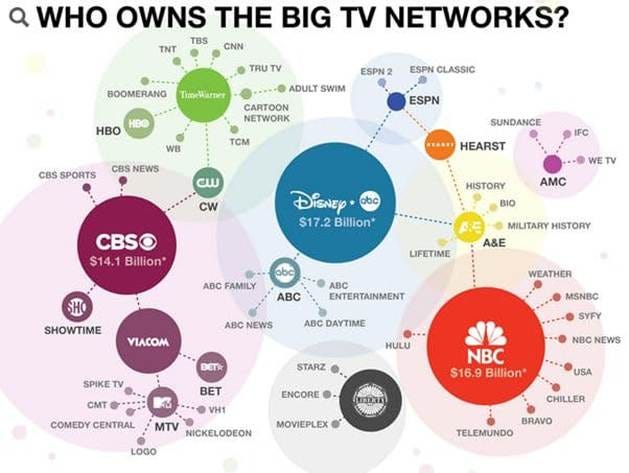
When The Manipulator In Chief delivered his prime-time address on newly declassified election documents, ABC and NBC declined to air it on their broadcast networks, CBS cut away before it concluded, and the remainder of the legacy media pivoted immediately to fact-checking commentary — because nothing protects the public from misinformation quite like ensuring they never hear the primary source material that might allow them to form their own opinion. The institutional logic is breathtaking in its circularity: the same networks that spent four years insisting that every presidential utterance deserved wall-to-wall coverage have quietly reserved the editorial right to decide which presidential utterances the public is sufficiently sophisticated to receive unfiltered. ABC is a Disney division, NBC belongs to Comcast’s NBCUniversal, and CBS operates under Paramount Global — three multinational conglomerates whose combined interests in entertainment, advertising, streaming, telecommunications, and government regulation extend considerably beyond any nostalgic commitment to the First Amendment they invoke whenever their own content is challenged. The press was never supposed to be the gatekeeper of which information reaches the public — that was always the public’s job, performed at the ballot box rather than the broadcast edit suite.
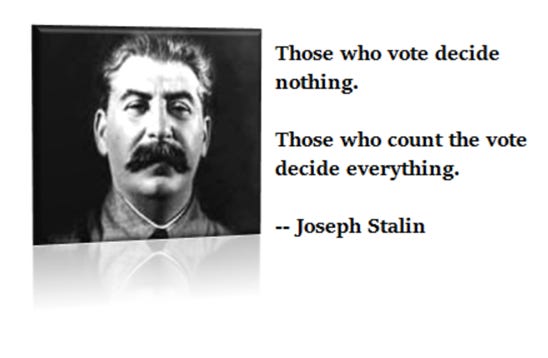
Rigging elections have been a passtime for thousands of years. Even Joseph Stalin commented on that practice famously saying its the people who count the votes who decide everything.
The Ministry of American Sovereignty has announced a minor procurement update: buried inside the $1.15 trillion FY2027 National Defence Authorization Act, Section 219 directs the Pentagon to create a permanent “executive agent” — an official whose statutory mandate is to expand and accelerate the integration of US and Israeli military technology, supply chains, co-production lines, and classified programs across missile defence, AI, counter-drone, directed energy, quantum, and biotechnology — a provision so significant that House leadership ensured it received no independent debate, no separate vote, and no amendment, after the Rules Committee twice refused to allow the bipartisan Massie-Khanna strike amendment to reach the floor. No other US ally has anything remotely like this — not Britain, not Japan, not Australia, not NATO — and as the Quincy Institute notes, the executive agent would hold precedence authority over the Pentagon’s own technology security office, effectively handing Israeli defence firms their own permanent promoter inside the Department of War. The constitutional footnote writes itself: Satanyahu has publicly described the integration plan as his own idea, which is the geopolitical equivalent of a foreign head of government announcing which section of your defence bill he prefers — and being accommodated by simple majority inside a must-pass bill under a rule forbidding amendment.

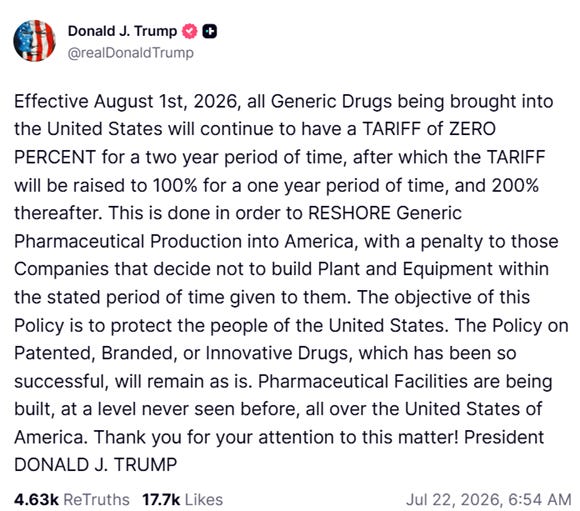
In a policy announcement that will delight domestic pharmaceutical lobbyists and alarm every American who has ever checked the price of their blood pressure medication, ‘Tariff-Man’ has announced a 100% tariff on imported generic drugs starting August 2028, rising to 200% a year later — which is the market economy’s elegant way of doubling the cost of medicines that 90% of Americans depend on in order to incentivise building factories that will take a decade to construct, produce drugs at multiples of current Indian costs, and achieve full operation approximately two administrations after the man proposing them has left office. India supplies nearly 40% of US generic drug volume — covering hypertension, diabetes, cancer, and infectious diseases — at a 30-50% manufacturing cost advantage that no Truth Social announcement can legislate away, meaning the tariff will either raise drug prices immediately, fail to reshore production, or achieve both simultaneously. The American patient — already financing groceries on credit cards at 21% interest — has been placed on a two-year countdown to paying considerably more for the medications keeping them alive.
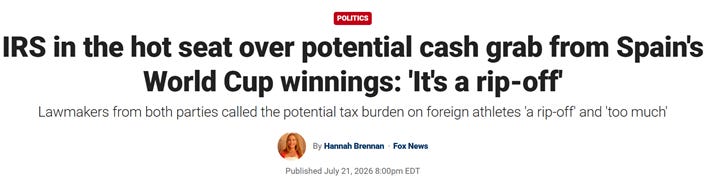
In a plot twist that required the World Cup to end before anyone noticed, Spain won $50 million in FIFA prize money on American soil only to discover that the IRS — the same institution that struggles to audit the Department of War — has found the bandwidth to potentially withhold 30% of a foreign football team’s winnings under its non-resident alien income tax rules, because nothing says “welcome to America” quite like demanding $15 million from the champions before they board the plane home. Bipartisan congressional outrage has duly erupted, with Republicans calling it “a ripoff” and Democrats calling it “wrong” — a rare moment of cross-aisle unity achieved not by healthcare, infrastructure, or the $40 trillion national debt, but by the prospect of Spain’s footballers getting a smaller cheque. The supreme irony is that the same government simultaneously charging a 20% Hormuz toll on global oil shipments, imposing 100% tariffs on generic drugs, and running the world’s most creative sanctioning operation has now been caught attempting to tax the World Cup trophy ceremony — confirming that in the Empire’s revenue model, no victory lap is too small to monetise.
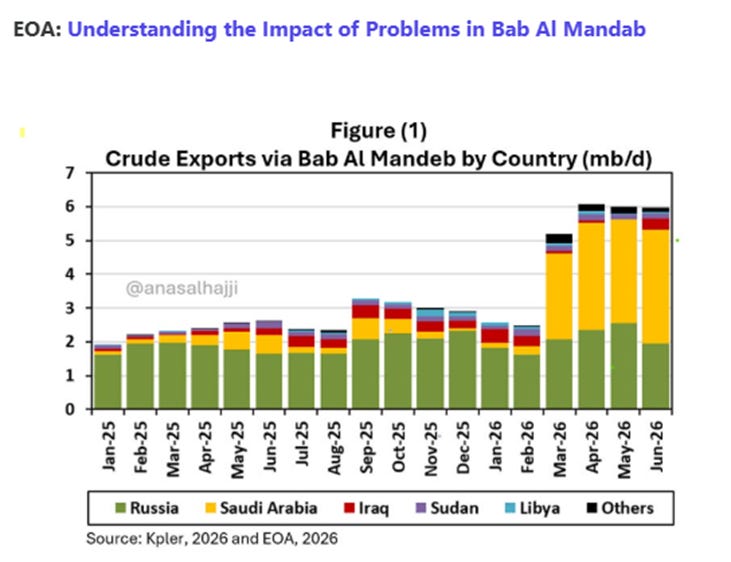
The Ministry of Regional Stability has issued a minor shipping update: Yemen’s Houthi rebels have announced a maritime embargo against Saudi Arabia, effective immediately, threatening to close the Bab al-Mandeb Strait to Saudi shipping — a chokepoint through which approximately 4.5 million barrels per day of Saudi crude exports transit southward toward Asian markets — in what Houthi spokesman described as an “equation of an eye for an eye“ in retaliation for a Saudi-led coalition attack on Sanaa International Airport. The timing is magnificent: the Strait of Hormuz is still closed for navigation, Qatar’s LNG facility is offline for three years, Russia’s refinery capacity has been systematically drone-struck to its lowest level since 2005, and the global energy market — which had briefly convinced itself that the geopolitical premium had been permanently erased — now faces the prospect of a second major maritime chokepoint threatening closure simultaneously. Analysts noted that the proclamation could mean anything from simple posturing to the effective closure of the Bab el-Mandeb Strait through missile and drone attacks against shipping, as became common during the Israel-Hamas war. Saudi Arabia’s East-West Pipeline alternative to Hormuz runs directly to the Red Sea — which is now precisely where the Houthis are pointing their drones.
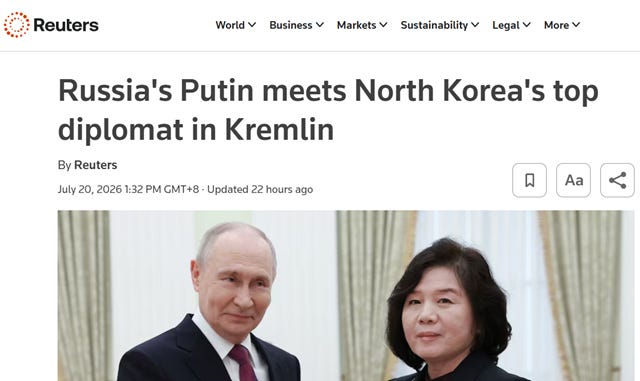
Tsar Vladimir met North Korean Foreign Minister at the Kremlin this week to receive ‘The Kim’ ‘s personal reaffirmation of “unconditional support” — a diplomatic visit that required no particular imagination to decode, given that Pyongyang has already deployed approximately 14,000 troops to Russian soil, shipped millions of artillery shells and ballistic missiles, and received in return advanced satellite technology, missile expertise, air defence systems, fuel, food, and diplomatic cover from the same country that Western sanctions were supposed to isolate into submission. The neocons who designed the sanctions architecture believed Russia could be economically strangled into compliance — and technically succeeded, in the sense that they accelerated the formation of an alternative military-industrial-financial ecosystem spanning Moscow, Pyongyang, Beijing, and Tehran that now cooperates across weapons production, supply chains, intelligence sharing, and diplomatic backing with the enthusiastic solidarity of nations that have concluded the Western-led order no longer serves their interests. Every asset seizure, every SWIFT exclusion, every trade restriction produced the same result: not capitulation but coalition — because nations facing existential economic pressure do not negotiate, they diversify their counterparties.
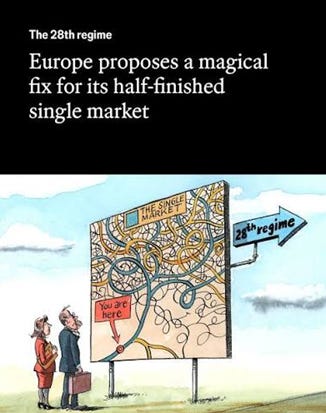
In the capital of Eurostan, Ursula The Witch and Super Mario have convened to discuss European competitiveness — which is Brussels-speak for announcing that the solution to problems created by too much centralised government is considerably more centralised government, this time rebranded as “One Europe, One Single Market” because calling it what it is would alarm the taxpayers financing it. Super Mario’s report correctly diagnosed Europe’s illnesses — stagnant productivity, unaffordable energy, fragmented capital markets, collapsing industrial competitiveness — while heroically declining to mention that Brussels created most of them through Net Zero mandates, carbon taxes, the Digital Services Act, ESG directives, and enough compliance requirements to bury a continent.
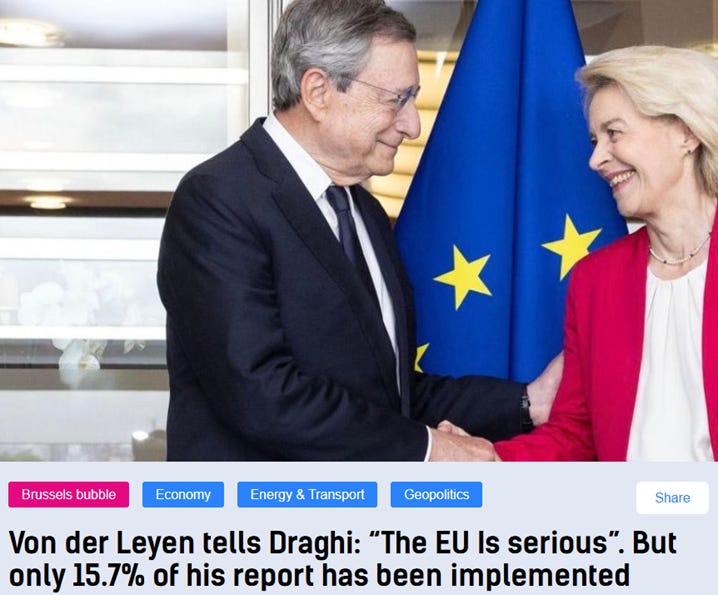
The proposed cure is €750-800 billion in additional annual investment through 2030 — approximately €4.8 trillion over six years — to be guided, subsidised, and de-risked by the same institutions that made private capital unwilling to invest in the first place, meaning taxpayers absorb the losses while politically connected corporations collect the profits. Of Super Mario’s 380 recommendations, a 2025 European Parliament study found only 11% had been adopted — yet Brussels celebrates “excellent progress” and demands more authority to implement the remaining 89% that nobody followed.
The Ministry of Peaceful Technological Advancement has produced its most clarifying product demonstration yet: at the world’s first full-size humanoid robot combat tournament in Shenzhen — organised by EngineAI, the company that previously went viral for kicking its own CEO across a room — a black robot named Matador had its head kicked clean off by a high-kick from White Eagle, continued throwing punches and kicks with its head dangling from its torso, then collapsed, crushed its own head beneath its body, watched the head fly off entirely, and finally fell — because apparently losing one’s head is no longer considered a disqualifying condition in either robotics competitions or geopolitical decision-making. The 32-team event featured EngineAI’s T800 humanoid platforms, where competitive edge comes down to software and tuning rather than hardware — which is the robotics industry’s elegant way of saying China is now hosting international tournaments for AI-powered killing machines and calling it sport. A robot that loses its head and keeps fighting is either the most impressive engineering demonstration of 2026 or the most accurate metaphor for global geopolitics — possibly both.
The Ministry of Internet Monetisation has unveiled its most ambitious initiative yet: Cloudflare’s Monetization Gateway, which will allow website owners to charge AI agents fractions of a cent per request using stablecoin micropayments over the x402 protocol — because the thirty-year bargain of trading content for human attention has collapsed now that AI crawlers consume content thousands of times for every visitor they send back, and somebody decided the logical response is to bill the robots. The architecture is elegant in its circularity: the same AI infrastructure boom that is destroying the advertising model that funded the free internet will now pay for the content it consumed to train itself, via stablecoins settled in under a second, handled entirely within Cloudflare’s global network of 330+ cities before the origin server ever sees the request. Cloudflare, positioned as the proxy layer between virtually every significant website and its visitors, has quietly accumulated the power to insert a payment checkpoint into any HTTP request on the internet — meaning the company that already controls a substantial fraction of global web traffic now also controls the payment rails for the agentic internet that is replacing it. The free internet was funded by human attention; the agentic internet will be funded by robot micropayments — and Cloudflare just built the tollbooth at the only road in town.
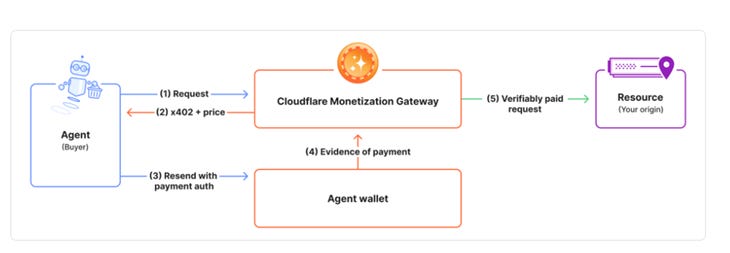
https://blog.cloudflare.com/monetization-gateway/
The IMF has once again reduced its global growth forecast to approximately 3% — well below the historical average — citing “persistent geopolitical tensions, expanding trade barriers, and growing uncertainty,” which is the Washington-based institution’s diplomatic way of acknowledging that the wars its largest shareholder started, funded, and declared won on Hour 1 of Day 1 are now visibly compounding on the global balance sheet. The economic logic is elegantly simple and consistently ignored: steel directed into armoured vehicles is unavailable for factories; microchips diverted into missile guidance systems are not powering data centres; governments absorbing trillions in war expenditure through debt issuance are crowding out private investment while delivering inflation to households who never voted for the adventure. Europe is busy dismantling decades of fiscal restraint to finance defence budgets it should have maintained all along; the US is approaching $40 trillion in federal obligations while simultaneously bombing Iran and arming Ukraine; and the IMF — headquartered in Washington, funded by Washington, and historically aligned with Washington’s economic preferences — has heroically concluded that all of this is creating “uncertainty.” History is blunt: financial exhaustion has toppled more governments than military defeat, and the invoice for the current war cycle is still being printed.
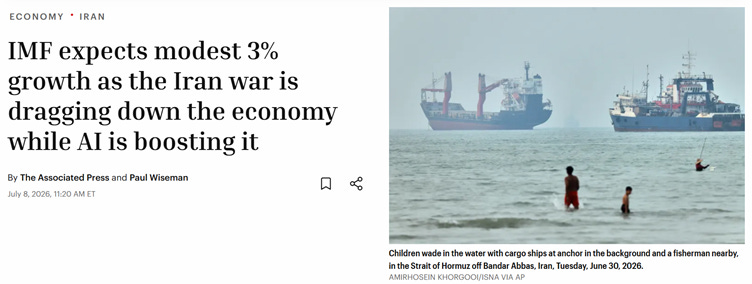
https://fortune.com/2026/07/08/imf-sluggish-economic-outlook-3-percent-ai-war-iran/
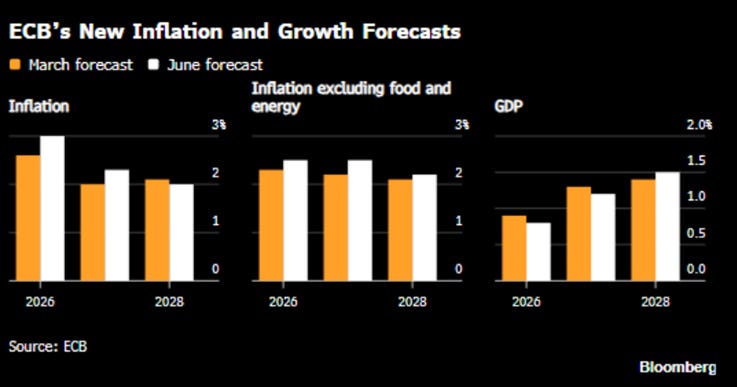
The ECB held rates at 2.25% on Thursday — pausing with the solemn gravitas of an institution that just discovered, after raising rates in the middle of a war-driven energy shock in both 2008 and 2011 and immediately reversing both decisions in tears, that perhaps it should wait for one more data point before making the same mistake a third time. Christine Lagarde, presiding over a continent importing record Russian LNG while sanctioning Russia, running its largest defence budgets since the Cold War while running fiscal deficits above its own rules, and now facing the admission that “the full inflationary impact of the energy shock has yet to play out,” delivered the ECB’s customary masterpiece of non-commitment — closely monitoring, data-dependent, one meeting at a time — while the euro quietly extended its weakness against the dollar, Bund yields stayed elevated, and markets priced in 48 more basis points of hikes by year-end. The institution that was “at the vanguard” of G7 central banks by hiking first is now pausing to consult “fresh forecasts from staff economists” — which is Brussels-speak for waiting until September to discover what the oil market already knows today.
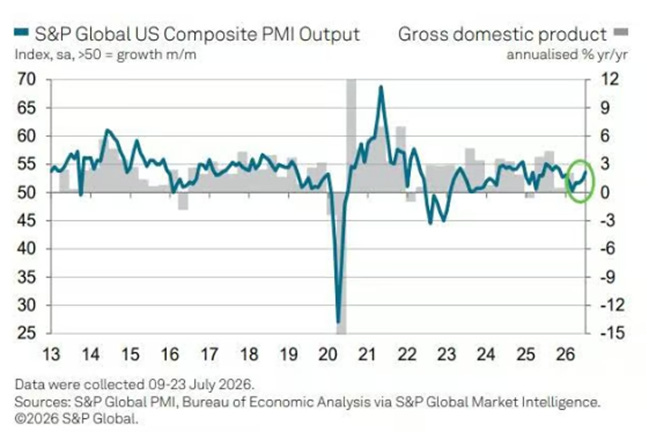
US July’s flash PMIs delivered the customary “mixed but positive” verdict that S&P Global produces with the seasonal reliability of a Swiss watch: Manufacturing slipped to a 4-month low of 53.8 while Services surged to an 8-month high of 53.6, with the composite broadly consistent with GDP growing at an annualised 2.0% — a meaningful acceleration from Q2’s 1.2% — which sounds encouraging until one reads the footnotes, where S&P Global’s own chief economist warns that “some of this improvement may prove short-lived as July saw hospitality spend boosted by the FIFA World Cup and USA 250th anniversary activities“ — meaning the economy’s best quarter in months was partially powered by Americans watching soccer and eating birthday cake.
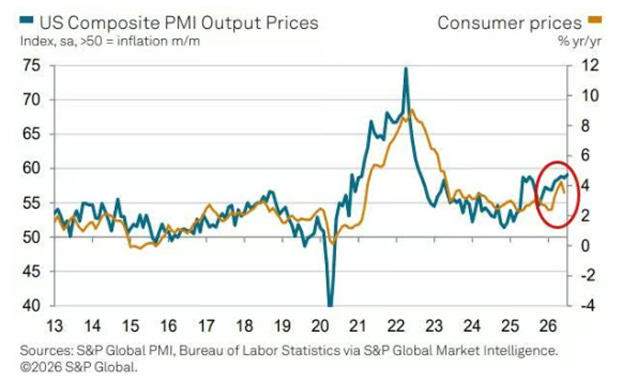
The supply chain detail is less festive: July saw an intensification of supply chain delays and a renewed upturn in price pressures, with events over recent days in the Middle East having “only further exacerbated these supply chain and price worries” — which is S&P Global’s tactful way of confirming that the same war the consensus declared over in June is now visibly repricing the Q3 economic outlook from “accelerating growth” to “accelerating inflation.”
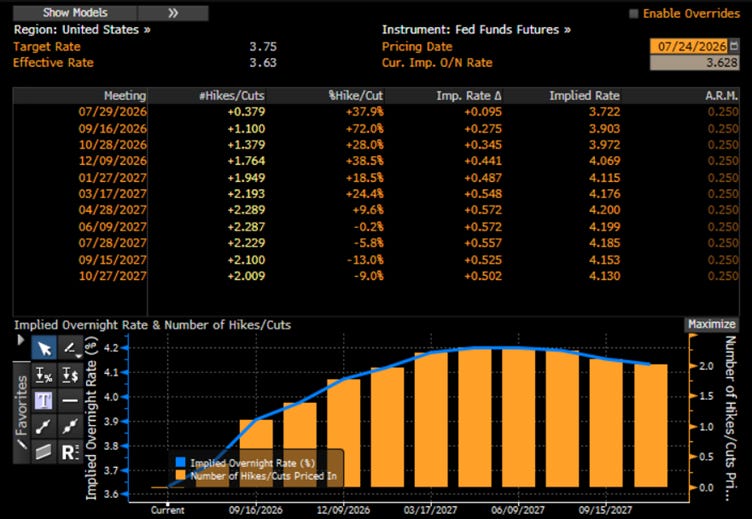
Ahead of next week’s second ‘Warsh-ington’ show, Wall Street’s endlessly imaginative EYIs — who spent the entire first half of 2026 pricing in rate cuts with the conviction of men who had read the script — have now fully pivoted to pricing in a September hike and three total rate hikes in 2026 with a 76% probability, retaining throughout the unshakeable confidence of forecasters whose track record would embarrass a coin flip. The foundational truth they continue to resist is simple: the Fed doesn’t control the cycle — the cycle controls the Fed — and the bond market set this rate path months ago while the FOMC was still discussing the possibility of cuts. The Fed, true to form, remains the passenger in seat 32B, occasionally leaning forward to ask what altitude they’re flying at and being handed a laminated card about price stability, while the bond market does the actual flying, sets the actual course, and lands the actual plane — then waits politely for the Fed’s press conference to announce the destination everyone already reached.
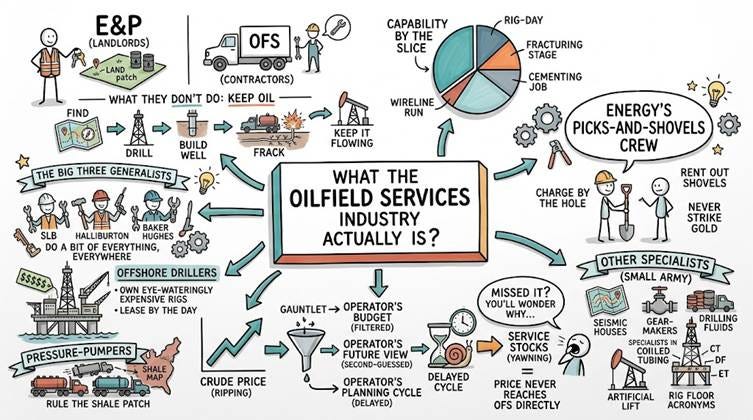
If the exploration-and-production (E&P) companies are the landlords of the oil patch — they own the dirt, the reserves and the barrels — then the oilfield services (OFS) industry is the contractor, the tool-rental yard and the guys who actually show up in the trucks. Service firms find the oil, drill for it, build the well, frack it and keep it flowing for years. What they don’t do is keep the oil. They sell capability by the slice: a rig-day here, a fracturing stage there, a cementing job, a wireline run. Think of them as energy’s picks-and-shovels crew — never striking gold themselves, just renting out the shovels and charging by the hole.
That one distinction explains almost everything. An E&P company gets paid when a barrel sells; a service company gets paid for showing up and doing the job. So, the oil price never reaches OFS directly — it has to survive a gauntlet first: filtered through the operator’s budget, second-guessed by the operator’s view of the future, and delayed by the operator’s famously unhurried planning cycle. Grasp that relay race and you understand the sector; miss it, and you’ll keep wondering why service stocks yawn while crude rips.
The cast list is sprawling: the Big Three generalists (SLB, Halliburton, Baker Hughes) who do a bit of everything, everywhere; the offshore drillers who own eye-wateringly expensive rigs and lease them by the day; the pressure-pumpers who rule the shale patch; plus seismic houses, gear-makers and a small army of specialists in coiled tubing, drilling fluids, artificial lift and every other acronym on the rig floor.
What ties this circus together is one shared nerve: they all live and die by their customers’ drilling budgets. When operators green-light more wells, everybody sells more — more rig-days, more horsepower, more sand — and because the cost base barely moves in the short run, that extra revenue lands on the bottom line with a very satisfying thud. When operators slam the brakes, the same math runs in reverse, only faster and with more crying. It’s a capital-intensive, feast-or-famine business whose cycles make roller coasters look like gentle suggestions — glorious on the way up, stomach-dropping on the way down.
The service industry was born the day drilling got too complicated for one stubborn wildcatter and a lot of optimism. When the Spindletop gusher blew in on the Texas coast in 1901 — spraying oil for nine days before anyone could cap it — it launched the petroleum age and, almost immediately, a second business: selling the tools, pipe and know-how to do it again on purpose. From then on, the oil world had two tribes: the people who owned the oil, and the people who sold them the shovels.
In 1909, Howard Hughes Sr. patented the roller-cone bit that could actually chew through hard rock, collected the royalties, and — fun fact — bankrolled a dynasty of movies and aviation on the proceeds. In 1919, Erle P. Halliburton started pumping cement down wells to glue the casing to the rock, turning well-building from a dark art into a service you could invoice. And in 1927 the Schlumberger brothers dangled an electrical probe down a hole in France and read the rock like an X-ray. Drill bit, cement, measurement — the entire modern industry was sketched out before anyone had a television.
The post-war boom put the sector on steroids. Commercial hydraulic fracturing arrived in 1949, proving you could engineer a reservoir’s output rather than just pray for it. As the easy onshore barrels dried up, the industry waded into the water — the Gulf of Mexico, then the North Sea — and invented the offshore drilling contractor: a company that owns a spectacularly expensive rig and rents it out by the day, like a yacht that occasionally strikes oil. Then the 1973 and 1979 oil shocks sent prices vertical, money poured in, and everyone had a wonderful time.

Naturally, it ended in tears. Oil collapsed in the mid-1980s, the U.S. rig count fell by roughly three-quarters, drilling contractors went bankrupt in batches, and a whole generation of rigs was scrapped or mothballed. The survivors did what survivors do — they merged. This is the crucible that forged the giants: Schlumberger swallowing specialists, Halliburton eventually pairing with Dresser, and Baker International joining Hughes Tool in 1987 to become Baker Hughes.
From the 1990s, operators quietly outsourced their brains to the service companies, which became the real keepers of drilling technology — directional and horizontal drilling, measurement-while-drilling, rotary steerable systems, 3-D seismic. The big bang came in 2000s North America, when horizontal drilling married multi-stage fracking and the two of them unlocked shale, turning the U.S. into the world’s largest oil and gas producer. And shale is a service company’s dream: a shale well isn’t so much discovered as manufactured, out of pipe, cement, sand, water and horsepower — nearly all of it supplied by, you guessed it, the service crew.
The latest chapter is about discipline, mostly learned the hard way. The 2014–16 crash and the 2020 pandemic shock did enormous damage, forced yet more consolidation (regulators blocked a Halliburton–Baker Hughes merger in 2016), and nudged the survivors toward spending restraint, digitalisation and side hustles in geothermal, carbon capture and electrification. Schlumberger even rebranded to the sleeker “SLB” in 2022. But strip away the makeover and the business is exactly what it was a century ago: sell activity, and live or die by the customer’s budget.

https://www.nps.gov/bith/learn/historyculture/oil-gas-industry.htm
A well isn’t a single heroic act — it’s a to-do list, and the OFS industry is just the specialists who each own one line of it. The chain runs from taking a photo of rock nobody has ever seen, to drilling and building the hole, to giving it a chemical pep talk, and finally to babysitting it for the next few decades. Every link has its own economics, its own rivals, and its own moment in the cycle when the phone starts ringing.
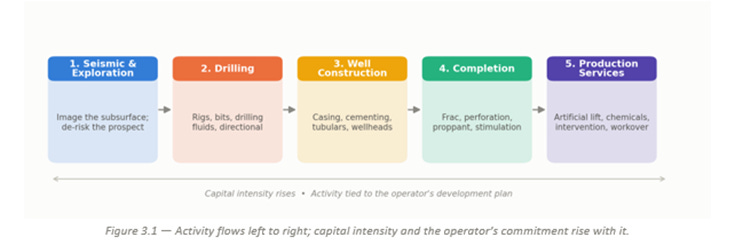
Before anyone buries a dollar’s worth of steel, they’d quite like to know what’s down there. Seismic services thump acoustic energy into the ground and listen for the echoes, building 2-D, 3-D and eventually 4-D pictures of rock no human will ever see — using vibrator trucks on land or streamer-towing ships at sea, then a lot of computers to turn the noise into a map. It’s the most exploration-driven corner of the business, which is a polite way of saying it’s the first budget operators axe when they get nervous and the last, they restore when they cheer up. Pure-play seismic has historically been one of the loneliest jobs in the patch.
Target chosen, time to make a hole. Drilling services cover the rig itself (owned by contractors, rented by the day) plus everything that makes it work: bits, drilling “mud” that lubricates and keeps downhole pressure in check, and the directional and measurement-while-drilling gear that can steer a wellbore two miles down and several miles sideways to hit a target the size of a room. The day-rate is the most-watched price in the whole industry, swinging with every shift in rig supply and demand — and offshore, where a top-tier drillship can bill several hundred thousand dollars a day, the swings will give you vertigo.
Drilling makes a hole; construction makes a well. Steel casing goes in and gets cemented to the rock to wall off geological zones, protect the drinking water and give the well a spine. This is the world of casing and tubing, cementing crews and pumps, wellheads, and — offshore — the subsea trees and blowout preventers perched on top to keep everything under control. It’s also where reputations live or die: when a well ends up on the evening news, it’s almost always a failure of construction or control. Nobody remembers a flawless cement job; everybody remembers a bad one.
A finished well still has to be persuaded to actually produce. Completion is the stimulation phase, and in the shale era it’s become the biggest single line on the service bill. You perforate the casing to open flow paths, then hydraulically fracture the rock — blasting in water, chemicals and sand at enough pressure to crack it and prop the cracks open. That takes armies of hydraulic horsepower and industrial quantities of sand and water. Because it’s both the priciest and the most postponeable step, it’s the industry’s swing factor: operators can drill wells and leave them uncompleted (the “DUC” backlog), then finish them when prices perk up — which makes completion spending a real-time mood ring for operator confidence.
Keep reading with a 7-day free trial
Subscribe to The Macro Butler’s Substack to keep reading this post and get 7 days of free access to the full post archives.