
THE REAL BULL...
How to recognize, trust, and trade a genuine bull market — with gold as lens?

The Week That It Was…
The last week of Q3’s first month arrived with the reliable punctuality of a bill nobody asked for: macro investors survived two central bank performances — the FOMC, where the Fed confirmed with great solemnity that it remained data-dependent, uncertain, and monitoring developments closely, and the Bank of England, which delivered the same message in a slightly more apologetic tone. The real entertainment arrived in the busiest earnings week of the season: 174 S&P 500 companies reported, headlined by four remaining Magnificent 7.
The Ministry of Controlled Escalation announces a minor geographical expansion of the war cycle: the Malthusian Dancer on high heels from Kyiv has struck Iranian commercial vessels in the Caspian Sea — a body of water approximately 1,200 kilometres from Ukraine’s border — killing one Iranian sailor and wounding others, thereby opening what military analysts are carefully describing as “a new front” and what everyone else recognises as the moment the Ukraine conflict formally merged with the US-Iran war into a single unified geopolitical catastrophe.

Iran’s Foreign Ministry summoned Ukraine’s chargé d’affaires, condemned the attack as a “hostile and criminal act” violating Article 2(4) of the UN Charter, and warned it would defend its national interests — Iran, which has spent months insisting it was not a participant in the Russia-Ukraine conflict, now finding itself torpedoed into it via the Caspian.

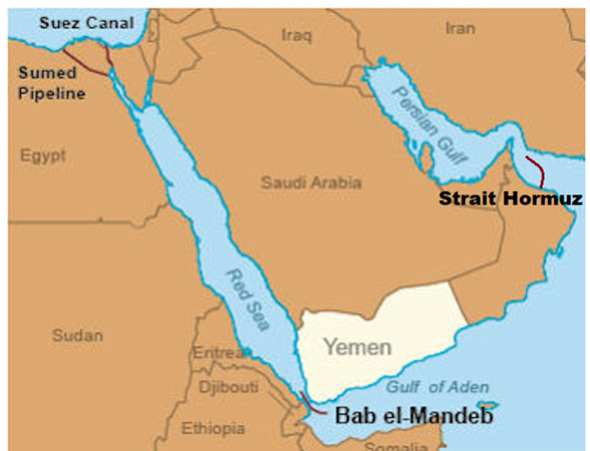
The Ministry of Controlled Regional Conflicts has issued a minor geographic clarification: what began as a US-Israel operation against Iran’s nuclear programme has now simultaneously closed the Strait of Hormuz via IRGC mines, triggered Houthi tanker strikes blocking the Bab el-Mandeb, drawn Ukraine into Caspian Sea operations against Iranian vessels, produced a Ukrainian security agreement with Saudi Arabia to counter Iranian-designed drones, meaning the Malthusian Dancer on high heels has successfully inserted Ukraine into the Middle East war while fighting Russia in Eastern Europe and threatening Belarus simultaneously, a geopolitical multitasking achievement that would be impressive if it weren’t catastrophic. The feedback loops now assembling themselves require no imagination: Iran recognises Crimea and the Donbas as Russian territory; Ukraine supports ethnic insurgent groups inside Iran; Iran attacks Ukraine-linked vessels in additional sea lanes; Russia supplies satellite imagery to Iranian targeting systems; North Korea sends another 30,000 troops. Armstrong’s computer model, which has been warning since 2024 that 2027 represents a genuine World War III inflection point, is watching the architecture assemble itself with the grim satisfaction of a forecast that nobody wanted to be correct.

In a development that will stun precisely nobody who has been reading the fine print of a war declared won on Hour 1 of Day 1, the US Strategic Petroleum Reserve has fallen to 319 million barrels — its lowest level in over 40 years — draining at 6.4 million barrels per week toward a critical minimum threshold of 250 million barrels needed to maintain the physical integrity of its storage caverns, which it will reach in approximately 11 weeks, around early October, at which point the world’s largest emergency oil reserve will have become a geological liability rather than an energy asset. The simultaneous closure of the Strait of Hormuz and the Bab el-Mandeb — the first time in modern history both chokepoints have been blocked simultaneously, together carrying roughly a quarter of global seaborne oil — has driven OECD inventories toward their lowest level since 2003, US gasoline stocks 7% below the five-year average, distillates 10% below, and global refining margins to record highs, while the IEA warns there is “no room for complacency” — the bureaucratic equivalent of a fire alarm installed after the building has already ignited.
WTI Oil Price (blue line); US Strategic Petroleum Reserve (red line).
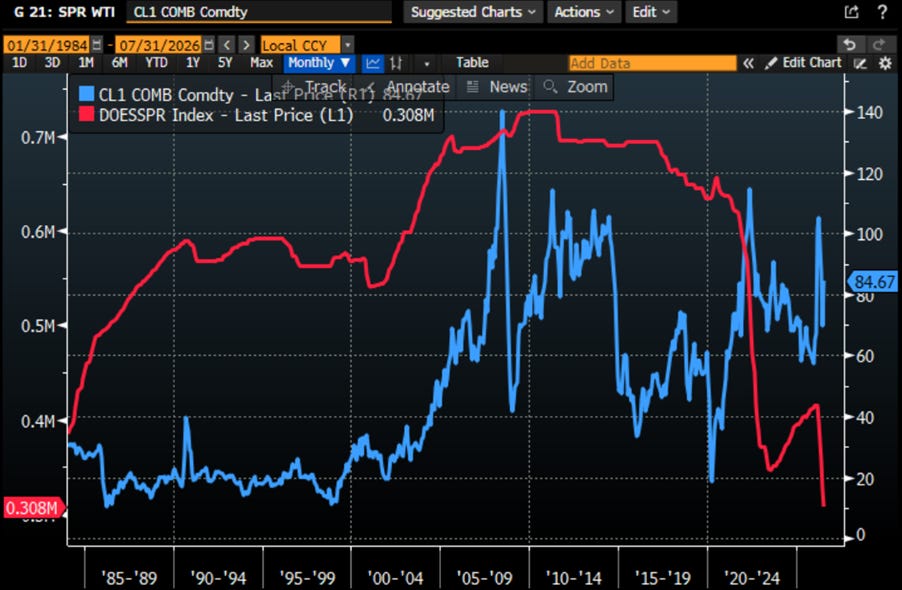
Brent crude has broken above $100 per barrel — that rarest of macro events that was simultaneously obvious, inevitable, and somehow still surprising to the same consensus that spent June celebrating cheap energy from a ceasefire now maintained exclusively by press releases and habit. The demand destruction that follows $100 oil is the market’s blunt instrument for balancing a supply crisis that diplomacy has failed to resolve — effective, certainly, but with the surgical precision of treating a headache with a hammer, carrying a stagflation risk. The SPR — now at a 40-year low, draining at 6.4 million barrels per week, and approaching minimum operational threshold in approximately 11 weeks — has provided the crucial bridge between the war that was won on Day 1 and the supply crisis that has been compounding ever since, but no emergency reserve can permanently replace 15-17% of global seaborne oil supply lost to simultaneous chokepoint closures. The world is navigating territory that has no modern precedent, no established playbook, and no resolution timeline that doesn’t depend on a geopolitical outcome that neither Washington nor Tehran has shown any inclination to deliver.
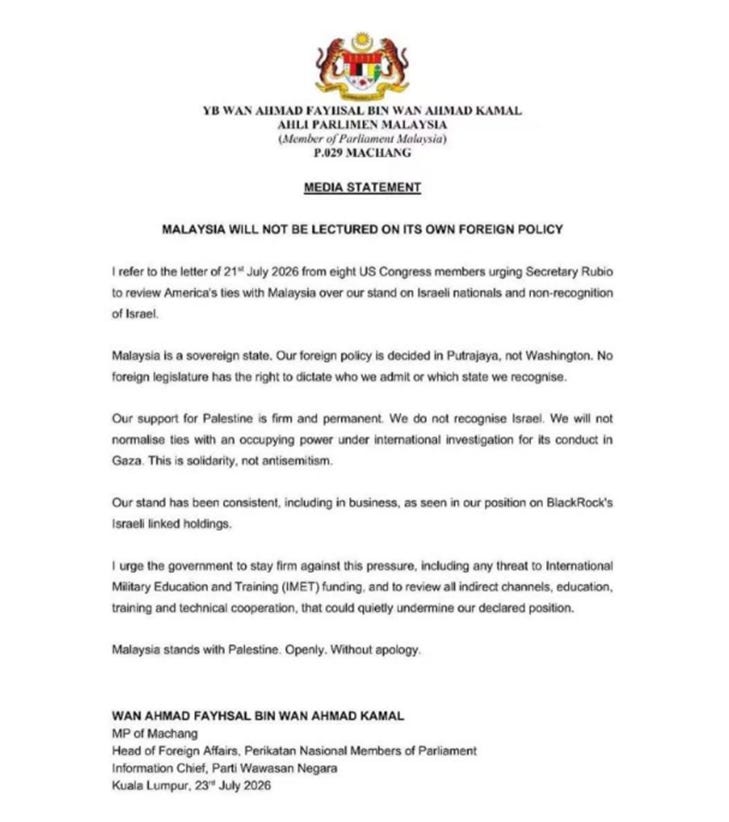
Malaysian MP Wan Ahmad Fayhsal has delivered Washington’s eight Congress members a crisp diplomatic lesson in the difference between an ally and a vassal, responding to their July 21 letter urging Secretary Rubio to review America’s ties with Malaysia over its non-recognition of Israel with the kind of sovereign clarity that Brussels, London, and most of NATO abandoned approximately three aid packages ago. The statement is admirably succinct: Malaysia’s foreign policy is decided in Putrajaya, not Washington; no foreign legislature has the right to dictate who Kuala Lumpur admits or which state it recognises; support for Palestine is “firm and permanent”; and the position extends to business, as demonstrated by Malaysia’s stand on BlackRock’s Israeli-linked holdings. The MP further urged his own government to resist any threats to International Military Education and Training funding and to review all indirect channels that could quietly undermine Malaysia’s declared position — a pre-emptive defence against the Empire’s preferred method of achieving through technical cooperation what it cannot achieve through diplomacy. Eight US Congress members attempted to leverage a $700 million military aid relationship to change a sovereign nation’s foreign policy recognition decisions and received in return a two-page media statement ending with “Malaysia stands with Palestine. Openly. Without apology.”
Documentary footage from British filmmaker Alex Holder has delivered the Iran war’s most clarifying artefact: The deceased Malthusian In Chief Graham, watching The Manipulator In Chief announce the opening strikes on Fox News, laughing aloud and gushing “Look what we’ve done here. I almost cried. How long have we been pushing this?“ — before reporting that Donald Copperfield told him “he’s jacked” and “loves blowing stuff up,” a sentence delivered while the opening salvo had already killed over 150 civilians including girls aged 7 to 12 at an elementary school in Minab. The footage also captures Graham on a March 4 phone call with Satanyahu, proposing to lobby The Manipulator In Chief into joining Israel’s war with Lebanon’s Hezbollah — only for Satanyahu, the man Graham spent years describing as insufficiently aggressive, to tell him to “concentrate on Iran first“ and that Lebanon “can always be done later,” making Satanyahu the relative voice of restraint in a conversation that would have been unthinkable as satire eighteen months ago. In early March, Graham predicted Iranian cities would start “losing control” within “three or four weeks” — five months later, no cities have fallen, the Iranian government’s support has been galvanised, and Graham’s final recorded words expressed frustration that Donald Copperfield was “letting this thing slip away” by signing a peace MOU.
The Ministry of Naval Innovation has unveiled its latest contribution to the post-human battlefield: the Global Autonomous Reconnaissance Craft — a small container-transportable suicide drone boat carrying 454 kilograms of explosive payload, successfully tested at RIMPAC 2026 by detonating two units against the decommissioned USS Peleliu, which had already absorbed missiles, aircraft, submarines, and land-based fire before the drone boats arrived to deliver what the military tastefully calls “localized blast, structural deformation, and flooding.” A Texas shipyard is preparing to mass-produce these vessels by the thousands, the Pentagon’s next procurement cycle will focus on stockpiling millions of aerial and maritime one-way attack drones, and the Ministry of Peace notes with quiet satisfaction that the Empire has effectively adopted Ukraine’s Houthi-inspired drone boat playbook — the same playbook that has been closing global shipping lanes, striking tankers, and disrupting 15% of world oil supply since February — and called it innovation.

The Ministry of Public Health Accountability convened a hearing this week in which Dr. Frankenstein Fauci — the man who spent the pandemic insisting he represented science itself — invoked his Fifth Amendment right against self-incrimination over and over, on the advice of counsel, declining to answer questions about COVID origins, gain-of-function research funding, and the inconvenient discrepancies between his public statements and his own recently released private diary entries. The theatrical irony is exquisite: legal scholars had spent weeks insisting Fauci could not plead the Fifth because Biden’s pre-emptive pardon had removed the risk of self-incrimination, he was invoking it to avoid — meaning either the pardon was unnecessary or the Fifth Amendment plea is an admission that today’s testimony carries fresh legal jeopardy the pardon cannot cover. Chairman Rand Paul reminded Fauci that federal law makes it illegal to refuse to answer questions pertinent to a congressional inquiry, then had Fauci’s lawyer forcibly removed from the chamber to a round of applause, in a scene that captured the entire post-pandemic reckoning: the man who was “the science” now silent, the pardon that was supposed to protect him now proving he needs protecting, and the accountability that was promised now reduced to a procedural standoff over which amendment applies.
In a revelation that will surprise nobody who has ever read the word “enzymes” on a cheese label and wondered what it was hiding, roughly 90-95% of American cheese is now produced using fermentation-produced chymosin — a coagulant manufactured by genetically engineered microorganisms — a technology pioneered by Pfizer in the 1980s and waved through by the FDA in 1990 via the GRAS process, which is the regulatory equivalent of a company grading its own homework and the government stamping “looks fine to me.” The mechanism by which America’s oldest food quietly went genetically modified is instructive: nobody held a referendum, no consumers marched demanding GMO cheese enzymes, the corporation simply submitted its data, the regulator approved it, manufacturers adopted it because it was cheaper, and thirty years later the traditional calf rennet had vanished from the mass market while everyone wondered aloud why dairy intolerance keeps rising and America keeps winning the title of least healthy developed nation. The pièce de résistance arrives in a 2024 USDA document admitting regulators cannot even determine the origin of an enzyme sample after production — meaning the government approved a process it subsequently became incapable of tracing, then permitted it all to hide behind the word “enzymes.”

https://hfpappexternal.fda.gov/scripts/fdcc/index.cfm?id=55FR10932&set=FinalRules
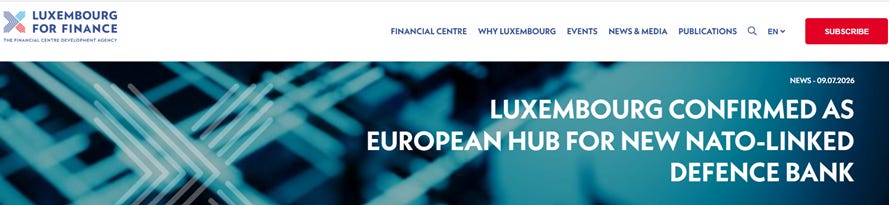
The Ministry of Collective Security has unveiled its most ambitious financial innovation yet: the Defence, Security and Resilience Bank — a new multilateral institution modelled on the World Bank and the EBRD, with its European hub in Luxembourg, designed to channel financing to North Atlantic Terror Organization members’ defence industries by securing a AAA rating through paid-in sovereign capital and callable guarantees, because the continent that spent thirty years telling its own pension funds they couldn’t invest in weapons manufacturers has now decided the solution is to build a supranational bank whose explicit mandate is financing “conventional weapons systems, ammunition and munitions” — categories that “many other financial institutions are generally unwilling or unable to finance,” which is the diplomatic way of saying the ESG policies Europe imposed on its own banks have now made it impossible to arm itself without inventing a new institution exempt from those policies. Luxembourg, which hosts more investment fund assets than any country except the United States, will serve as the European hub — confirming that the continent’s preferred response to a defence emergency is to run it through a tax-efficient fund domicile with 660,000 inhabitants and no army. Founding members intend to make it operational in 2027 — approximately the same year China has been planning to resolve the Taiwan question.
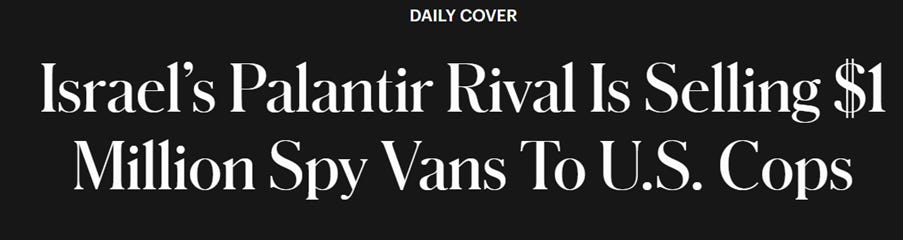
The Ministry of Community Policing has issued a routine procurement update: Texas has purchased four Chevrolet Tahoes from Israeli surveillance firm Cognyte for $4.5 million, each equipped with FalcoNet — a cellular interception platform that impersonates legitimate phone towers, forcing nearby mobile devices to connect to the police vehicle, whereupon investigators can identify devices, determine locations, and harvest cellular data — a capability previously reserved for counterterrorism operations that is now available in SUV format for a sheriff’s department near you, because nothing says “protect and serve” quite like a vehicle that surveils every phone within range without a warrant, a crime, or a suspect. The same technology can be carried in a backpack or mounted on helicopters, meaning the upgrade from vehicle to blanket aerial surveillance is one purchase order away. The irony that the Pentagon acknowledged this summer that Israel has been spying on the United States — while American police departments simultaneously purchase Israeli surveillance technology to spy on Americans — completes a circle so elegant it requires no commentary. None of these developments occurred overnight. They arrived one contract at a time. Welcome to the surveillance state where your every move is tracked, not just by your own government, but by whoever has access to the technology.
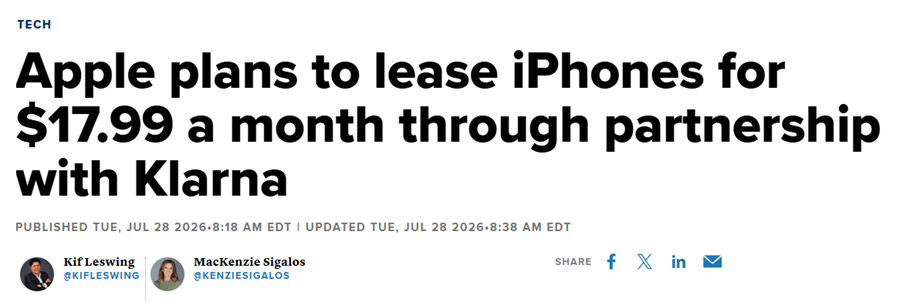
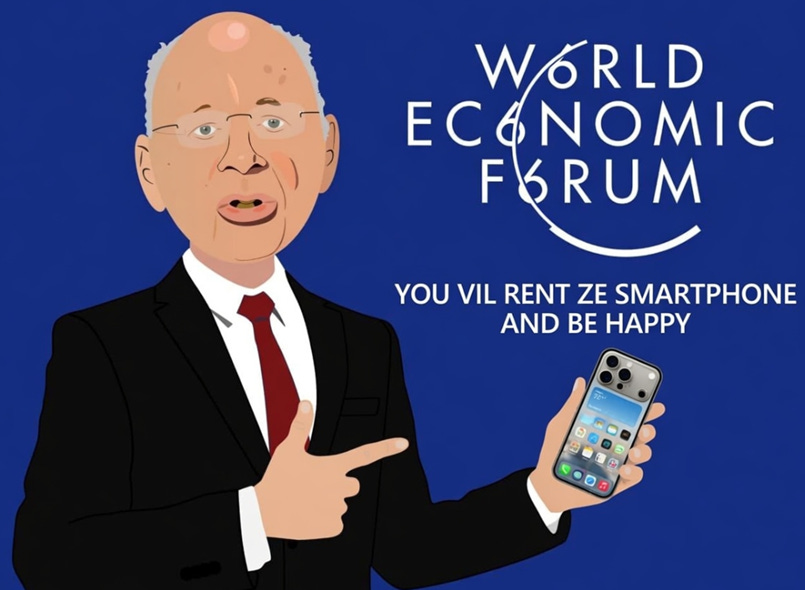
In a product launch that the World Economic Forum’s most enthusiastic strategists would recognise as the natural evolution of their favourite slogan, Apple and Klarna have unveiled “Apple Upgrade” — a leasing program allowing Americans to pay $17.99 per month for an iPhone they will never own, return it after 24 months, and immediately begin paying $17.99 per month for the next iPhone they will also never own, in a perpetual subscription to a product that has been progressively engineered to be unrepairable, irreplaceable, and indispensable. Apple quietly redirects attention from the full cost by quoting monthly lease rates rather than purchase prices — the iPhone 17 Pro costs $1,099 to buy outright but $31.99 per month to lease for two years, a financing structure MacRumors users have already diagnosed as “predatory trash” that follows precisely the auto industry playbook: introduce cheap monthly payments, extend terms to 36 months, raise prices, and watch the average payment balloon while the customer congratulates themselves on “affordability.” 51% of Americans already use installment plans for online purchases — meaning the nation that cannot afford groceries without a credit card is now being offered the opportunity to not own its phone either.
You will own nothing, rent Ze smartphone, pay monthly, return it in 24 months, and Apple will call it an upgrade — the WEF didn’t need a policy, it just needed a product launch.
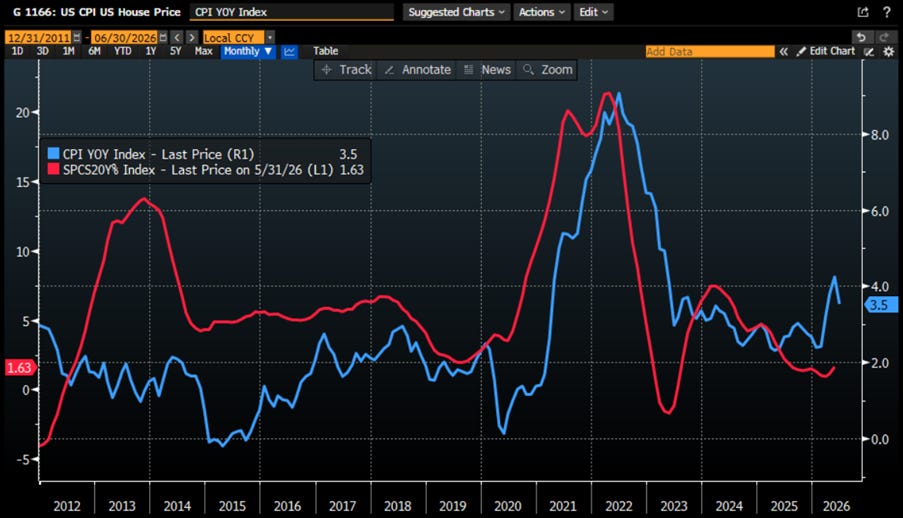
US home prices unexpectedly jumped 0.3% MoM in May — triple the 0.1% consensus estimate — lifting annual appreciation to +1.63% YoY, the fastest since July 2025, which the financial press is celebrating as a housing market recovery in the same breath that S&P’s own analyst confirms the gains were “negative in real terms” and driven primarily by seasonal factors that are “supporting headline price growth” — the data equivalent of announcing a patient’s temperature rose and calling it a health improvement. For the 12th consecutive month, inflation outpaced national home price appreciation, meaning American homeowners have spent a full year watching their largest asset decline in purchasing power while simultaneously paying 6.5% mortgage rates on a new purchase — a combination so inhospitable to first-time buyers that calling it an “affordability headwind” requires the same rhetorical restraint as describing Vesuvius as a “temperature event.”
US CPI YoY Change (blue line); US S&P Case-Shiller 20-City Composite City Home Price YoY Change (red line).
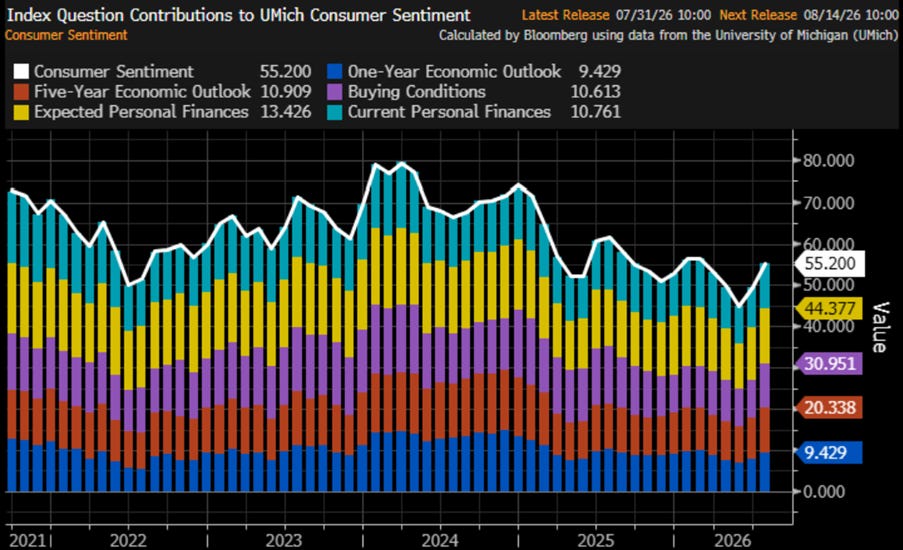
The University of Michigan’s final July Consumer Sentiment surged to 55.2 — its highest since February and beating the 54 expected — prompting the customary celebration that Americans are feeling better, which sounds encouraging until one recalls that “highest since February” simply means sentiment has clawed back to the level it occupied immediately before the Middle East excursion began, meaning the great achievement being toasted is that consumers now feel roughly as they did before everything got worse. Year-ahead inflation expectations “ticked down” to a still-scorching 4.2% — a number that remains substantially above February’s 3.4% and every single 2024 reading, but which qualifies as good news in a data environment where “less catastrophic” now passes for “improving.” The pièce de résistance arrives in the fine print: AI has officially become a “salient” factor for consumers, with commentary “negative on net” as Americans notice that the technology being celebrated by Wall Street as the future is simultaneously eyeing their jobs — meaning the consumer is now cheerful about gas prices and quietly terrified about employment, a combination the survey director has diplomatically filed under “salient.”
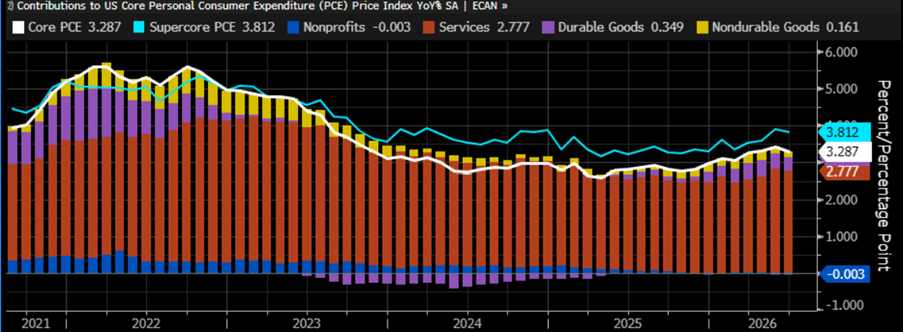
Wall Street erupted in celebration as headline PCE “deflated” -0.1% MoM in June — its first negative print since the COVID lockdowns of April 2020 — while Core PCE cooled to +0.1% MoM, dragging the annual rate down from 3.4% to 3.3%, prompting the consensus to declare, once again, inflation vanquished with all the confidence of a man who sees the tide go out and concludes the ocean has left permanently. The awkward footnote, which the celebration politely skips, is that June’s deflation was manufactured almost entirely by falling energy prices during the brief window when the Iran ceasefire briefly existed — a ceasefire that has since been formally cancelled, replaced with airstrikes, and accompanied by oil prices rising and two shipping chokepoints closing, none of which appears in June data because June ended before the sequel began. Services once again dominated the monthly rise, confirming that the sticky inflation remains stubbornly stuck while only the war-driven energy component provided the theatrical downside — meaning the market is celebrating an inflation print that measured the pause between two wars rather than the resolution of one.
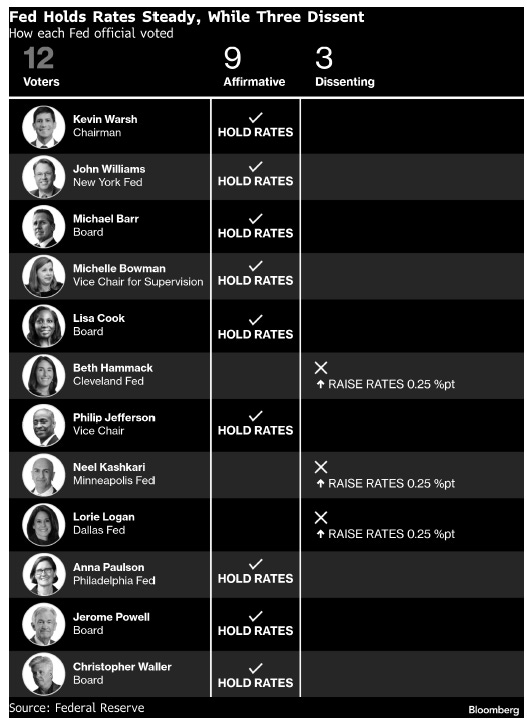
Fed Chairman Kevin Warsh would like everyone to know that holding interest rates exactly where they were is definitely not the central bank doing nothing — perish the thought — but rather a bold, decisive commitment to fighting inflation by, well, standing very still and looking committed.
The FOMC voted 9-3 to leave the funds rate parked at 3.5%–3.75%, which is to say nine officials agreed to keep agreeing with each other. The three dissenters — Dallas’s Lorie Logan, Cleveland’s Beth Hammack, and Minneapolis’s Neel Kashkari — had the temerity to suggest that fighting inflation might involve actually raising rates, a radical notion apparently still under committee review.
The split vote hinted that a growing faction suspects resurgent prices won’t be talked into submission. The rest of the statement was copy-pasted verbatim from June, right down to the solemn vow to “deliver price stability” — a phrase the committee has now pledged so many times it qualifies as a mantra rather than a forecast.
Chairman Warsh took a moment to clear up a “mistaken impression“ some households, businesses, and market professionals have picked up after five years of high inflation — the wild idea that the Fed’s real target might be a touch north of 2%. Where anyone could have gotten that notion after five years of watching prices do exactly that, he did not say.
“Let me reiterate: There is no soft inflation target,” he declared. “No soft implicit target, not on this committee’s watch.” Stirring stuff — the sort of line that sounds magnificent right up until you remember it was delivered immediately after the fifth straight decision to change nothing.
Because yes, that’s five holds in a row. Warsh, who took the job in May, has vowed many times to march inflation back to 2% while carefully declining to name the one tool that might do it. Pressed by reporters, he inched toward the forbidden word: if inflation stays hot, “interest rates could well be part of that solution” — though heaven forbid anyone think it would be the whole solution, or arrive on any particular date.
So why didn’t the Fed actually raise rates? Because, Warsh explained, market rates have conveniently risen on their own — investors kindly doing the central bank’s job for it — a development he took credit for, on the grounds that he stopped telling markets what to think and they promptly panicked in the right direction. Truly, leadership.
Meanwhile the backdrop keeps helpfully stoking the fire he’s committed to fighting with a garden hose he refuses to turn on: a simmering conflict, a fresh batch of tariffs, and an AI-fuelled demand boom. The labour market plods along, activity expands at a “solid pace,” productivity is strong — and inflation, the statement notes for the record, remains stubbornly “elevated” above the target Warsh insists is definitely, absolutely, not soft.
US 2-Year Yield (blue line); US FED Fund Rate (red line); US CPI YoY Change (green light).
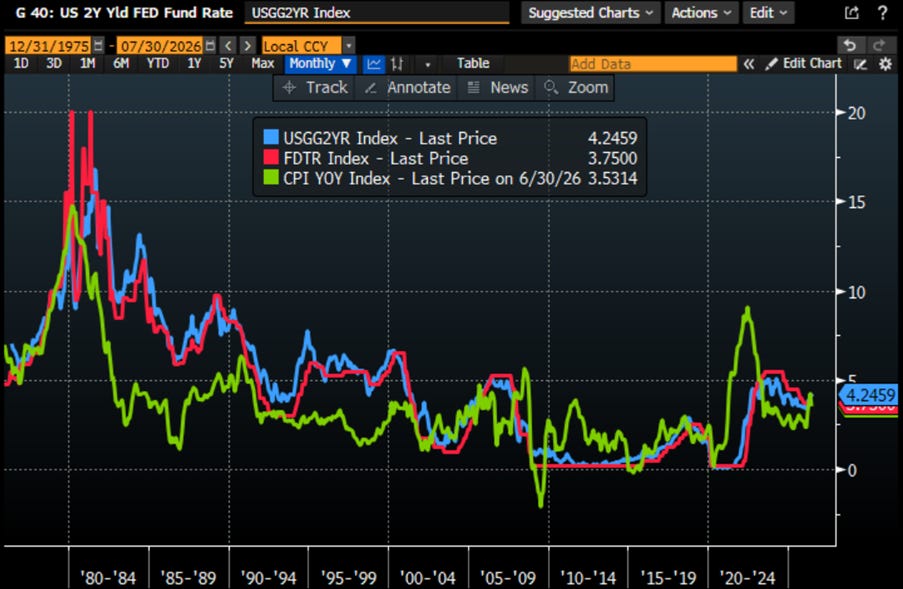
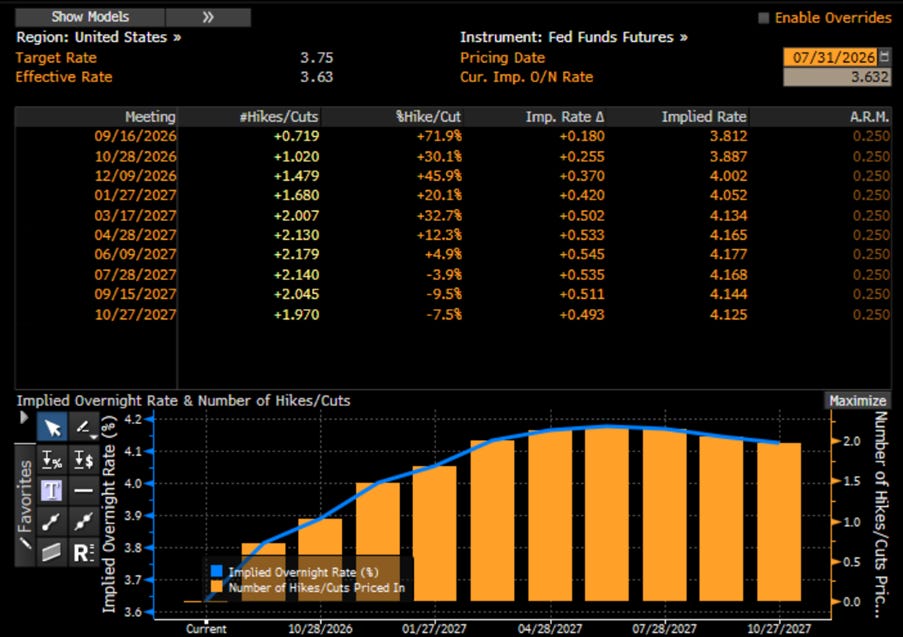
After a second ‘Warsh-ington’ show, Wall Street’s endlessly imaginative EYIs — who spent the entire first half of 2026 pricing in rate cuts with the conviction of men who had read the script — have now fully pivoted to pricing in a September hike with 71% probability and two total rate hikes in 2026 with a 48% probability, retaining throughout the unshakeable confidence of forecasters whose track record would embarrass a coin flip. The foundational truth they continue to resist is simple: the Fed doesn’t control the cycle — the cycle controls the Fed — and the bond market set this rate path months ago while the FOMC was still discussing the possibility of cuts. The Fed, true to form, remains the passenger in seat 32B, occasionally leaning forward to ask what altitude they’re flying at and being handed a laminated card about price stability, while the bond market does the actual flying, sets the actual course, and lands the actual plane — then waits politely for the Fed’s press conference to announce the destination everyone already reached.
Everyone claims to know a bull market when they see one. Far fewer can say precisely what one is, what actually causes it, or how to tell a durable trend apart from a noisy bounce.
A bull market is a price that keeps rising, shrugging off the occasional face-plant along the way. You’ve heard the shorthand — “up 20% from the lows” — but that’s a symptom, not a diagnosis. A 20% pop inside a long decline isn’t a bull market; it’s a dead cat with good hang-time. The real thing has structure and stubbornness: higher highs, higher lows, month after month, with buyers happily paying up every time the sellers try to slam the door.
It also helps to say which bull you mean. “The market” isn’t one animal — stocks, bonds, oil, metals and gold each run their own cycle, and they rarely agree on anything. Gold can be throwing a party while equities stare at the wall and oil quietly files for bankruptcy. So, whenever someone says, “the bull market,” ask them: which one, and versus what?
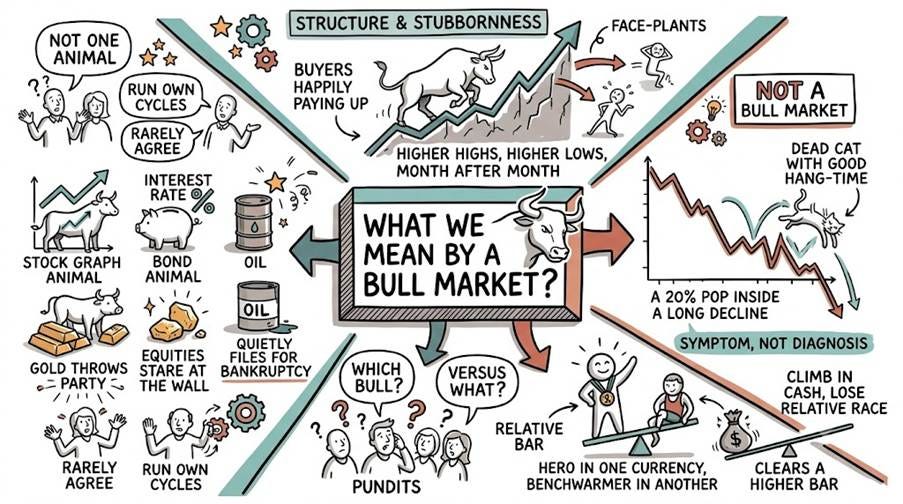
That “versus what?” is the bit most pundits skip — and it’s exactly where the real work hides. An asset can look like a hero in one currency and a benchwarmer in another or climb in cash terms while quietly losing a race to every rival. A genuine bull market clears a higher bar: it has to look good no matter how you slice it.

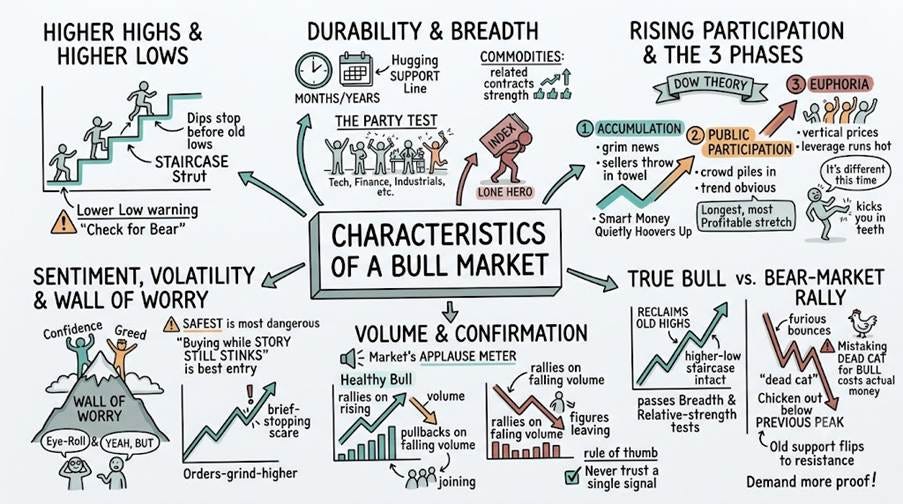
Bull markets aren’t just random noise that happened to wander uphill. They leave fingerprints and spotting them is most of the job. The biggest tell is the shape of the trend itself.
Picture a staircase, not a ramp. Prices climb, stop to catch their breath, dip a little — then charge off again to a new peak, while each dip refuses to sink as low as the last one. That’s the signature strut of a bull market: onward and upward, with the occasional dramatic sigh. As long as the staircase keeps rising, the bull is alive and well. The moment it starts building steps that go down — a lower low that actually sticks — that’s your cue to check whether the bull has quietly wandered off to become a bear.
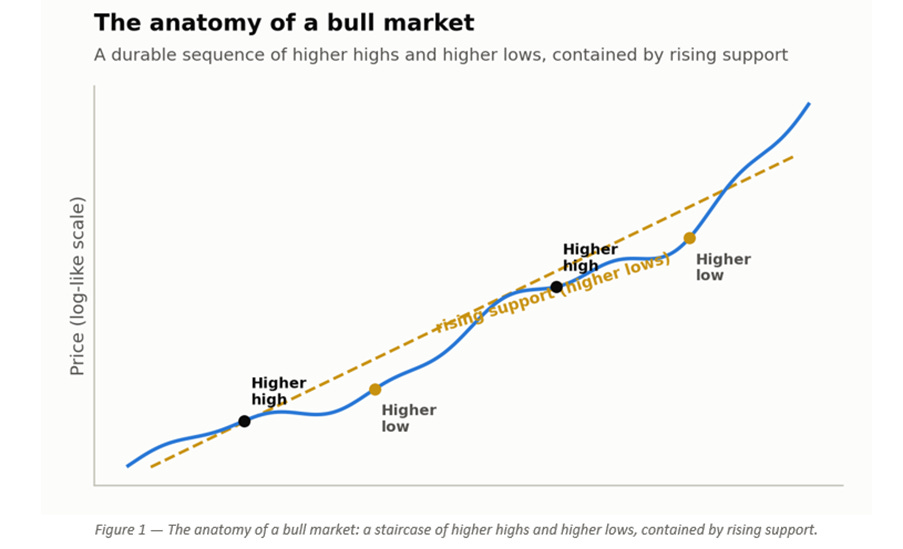
Bull markets run on a calendar of months and years, not a stopwatch. A one-week moonshot that fizzles by Friday means nothing; a trend that’s hugged its rising support line for eighteen months is making a speech. Then there’s breadth — the party test. In a healthy stock bull market, everyone’s invited: most sectors, most names, not just four mega-caps carrying the whole index on their backs. In commodities, it shows up as strength rippling across related contracts. When the crowd thins out and a lone hero is doing all the heavy lifting while everything around it sags, the bull is starting to feel its age.
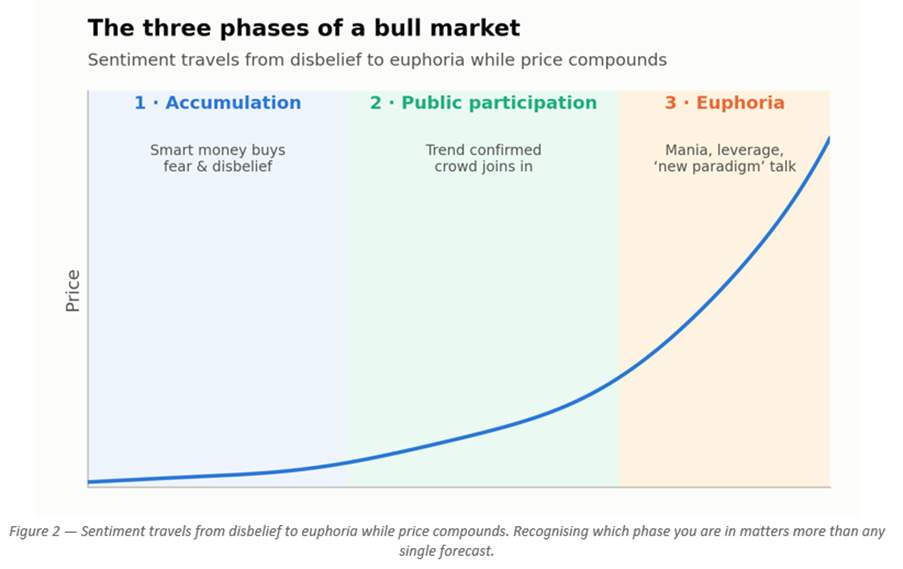
Old-school market lore, courtesy of Dow Theory, splits a bull market into three phases — and it endures because it describes people, not decades. First comes accumulation: the news is grim, everyone’s fed up, and the smart money quietly hoovers up shares from sellers who’ve thrown in the towel. Next is public participation: the trend gets obvious, the fundamentals actually show up, and the wider crowd piles in — the longest, most profitable stretch, and the one everyone wishes they’d caught earlier. Finally, euphoria: prices go vertical, leverage runs hot, and the crowd insists “it’s different this time.” It feels fantastic. It’s also where the bull kicks you in the teeth.
Bull markets love to “climb a wall of worry“ — and the worry is the whole point. Early on, nobody believes it: every rally is met with an eyeroll and a “yeah, but.” That’s actually the good news, because it means most people are still sitting on the sidelines with cash to eventually throw in. A healthy bull tends to grind higher in polite, orderly steps, occasionally interrupted by a heart-stopping scare that’s over before you’ve finished panicking. Only late in the game does the eye-rolling turn to confidence, and confidence to full-blown greed. The cruel joke: the moment everything feels safest is usually the most dangerous, and the entry that makes your stomach churn — buying while the story still stinks — is usually the best one.
One last thing worth eyeballing: volume, the market’s applause meter. In a healthy bull, the crowd shows up loudly to buy and slips out quietly during the dips — rallies on rising volume, pullbacks on falling volume. When that flips late in the trend — rallies on a whisper, sell-offs on a roar — it’s a hint the conviction is leaking out. Volume never runs the show by itself, but it’s a handy backup singer, telling a well-supported climb apart from one wheezing along on fumes. The rule of thumb: never trust a single signal on its own — make several of them agree before you believe the story.
The priciest mistake in the business is mistaking a bear-market rally for the real thing. Downtrends don’t slide politely downhill; they’re punctuated by furious bounces that claw back a chunk of the losses and feel, in the moment, exactly like sunrise. Spoiler: it’s a false dawn. A bear-market rally usually chickens out below the previous peak, stalls right where old support has flipped into resistance, and — the giveaway — only looks good through one lens: maybe strong in the local currency but not confirmed across currencies and not beating other assets. A genuine bull does the opposite: it reclaims old highs, keeps its higher-low staircase intact on the dips, and passes the breadth and relative-strength tests all at once. When in doubt, demand more proof, not less. Waiting a bit costs you a sliver of upside; mistaking a dead cat for a bull costs you actual money.
If the characteristics tell you what a bull market looks like, the causes tell you why it bothered to show up — and knowing the drivers helps you guess whether it’s here for a long weekend or a long stay. No single force pulls this off alone; bull markets are usually a group
The heavyweight champion of bull-market drivers is capital chasing the best expected return. Money is relentlessly comparison-shopping: it piles into wherever it thinks it’ll be treated best and abandons whatever looks stingy. So, when the expected return on cash and bonds gets crushed — central banks cut rates, yields sag, safe stuff stops paying — capital goes hunting for a better deal, and its flows lift whatever it lands on. For hard assets there’s a twist: what matters is the real expected return — what’s left after inflation takes its cut. When cash quietly loses purchasing power, a lump of metal that pays no interest suddenly wins the beauty contest by simply not losing, and the flows rotate toward gold. Falling real expected returns on everything else have long been gold’s favourite kind of weather.
Beneath the money tide sit the plain old fundamentals. For stocks it’s earnings; for oil it’s how much gets pumped versus burned; for gold it’s central banks stocking up, and investors wanting in. A bull market with staying power usually has a real supply-and-demand story holding it up — supply getting tighter, demand grinding higher, or both at once. And when solid fundamentals show up at the same party as easy money, the two get along famously and the drinks are on the house.
Markets are just people in a trench coat, and people move in herds. Once a trend gets going, nerves settle, cash pours in, and rising prices lure in even more buyers — a feedback loop that can carry a bull market way past what the fundamentals alone would ever sign off on. Don’t sneer at momentum; it’s a real, stubborn feature of markets, and it’s why trends run longer than every clever sceptic swears they can. The catch: the same herd instinct that powers the climb is exactly what turns the eventual exit into a stampede.
Keep reading with a 7-day free trial
Subscribe to The Macro Butler’s Substack to keep reading this post and get 7 days of free access to the full post archives.