
The ‘Warsh’ Trap
How the Fed Got 'Warsh'-Trapped While Washington Keeps Borrowing Its Way Into a Corner.

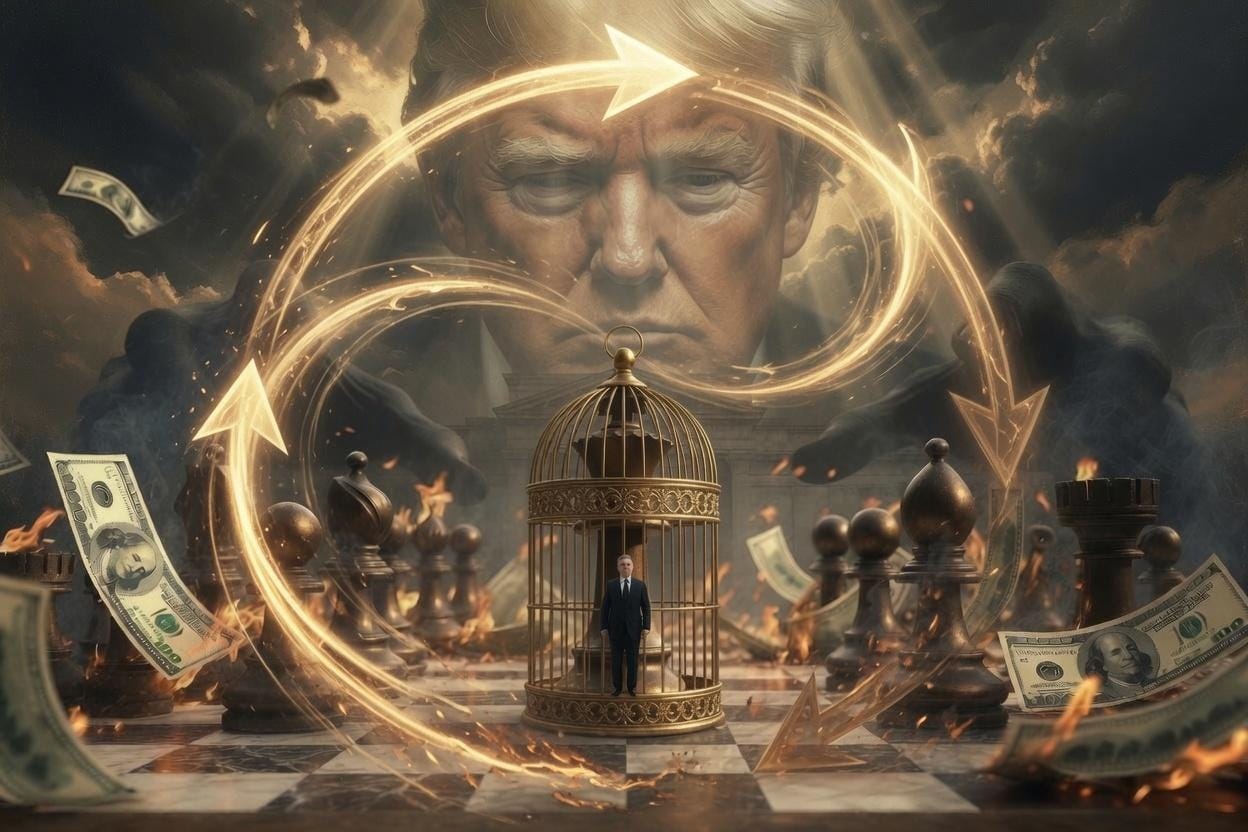
What’s behind the numbers?
Fed Chairman Kevin Warsh would like everyone to know that holding interest rates exactly where they were is definitely not the central bank doing nothing — perish the thought — but rather a bold, decisive commitment to fighting inflation by, well, standing very still and looking committed.
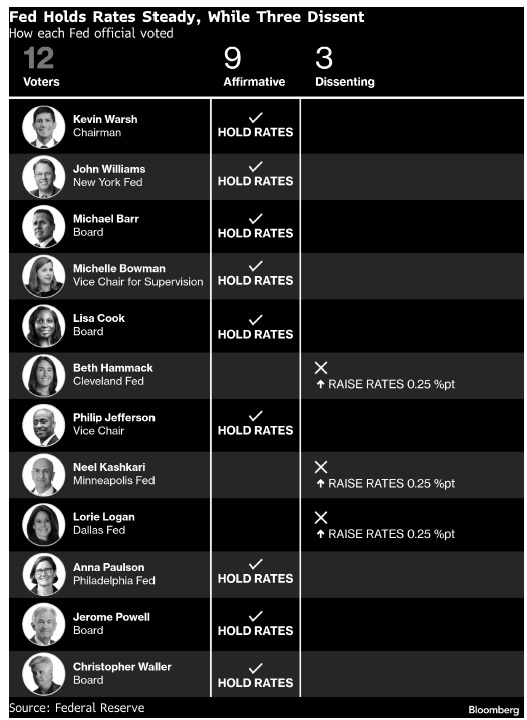
The FOMC voted 9-3 to leave the funds rate parked at 3.5%–3.75%, which is to say nine officials agreed to keep agreeing with each other. The three dissenters — Dallas’s Lorie Logan, Cleveland’s Beth Hammack, and Minneapolis’s Neel Kashkari — had the temerity to suggest that fighting inflation might involve actually raising rates, a radical notion apparently still under committee review.
The split vote hinted that a growing faction suspects resurgent prices won’t be talked into submission. The rest of the statement was copy-pasted verbatim from June, right down to the solemn vow to “deliver price stability” — a phrase the committee has now pledged so many times it qualifies as a mantra rather than a forecast.
Chairman Warsh took a moment to clear up a “mistaken impression“ some households, businesses, and market professionals have picked up after five years of high inflation — the wild idea that the Fed’s real target might be a touch north of 2%. Where anyone could have gotten that notion after five years of watching prices do exactly that, he did not say.
“Let me reiterate: There is no soft inflation target,” he declared. “No soft implicit target, not on this committee’s watch.” Stirring stuff — the sort of line that sounds magnificent right up until you remember it was delivered immediately after the fifth straight decision to change nothing.
Because yes, that’s five holds in a row. Warsh, who took the job in May, has vowed many times to march inflation back to 2% while carefully declining to name the one tool that might do it. Pressed by reporters, he inched toward the forbidden word: if inflation stays hot, “interest rates could well be part of that solution” — though heaven forbid anyone think it would be the whole solution, or arrive on any particular date.
So why didn’t the Fed actually raise rates? Because, Warsh explained, market rates have conveniently risen on their own — investors kindly doing the central bank’s job for it — a development he took credit for, on the grounds that he stopped telling markets what to think and they promptly panicked in the right direction. Truly, leadership.
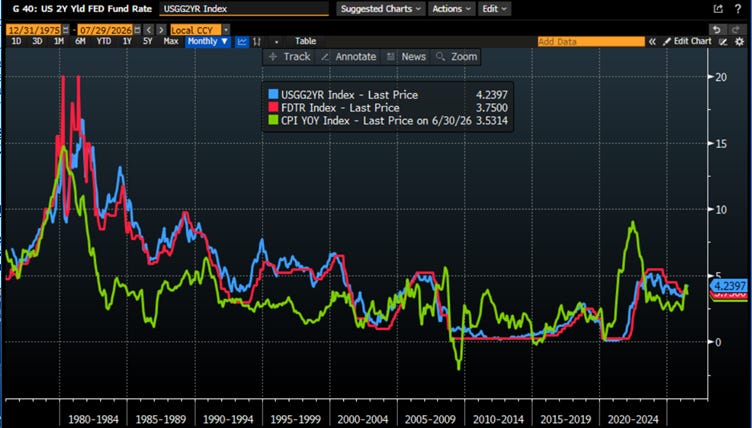
Meanwhile the backdrop keeps helpfully stoking the fire he’s committed to fighting with a garden hose he refuses to turn on: a simmering conflict, a fresh batch of tariffs, and an AI-fuelled demand boom. The labour market plods along, activity expands at a “solid pace,” productivity is strong — and inflation, the statement notes for the record, remains stubbornly “elevated” above the target Warsh insists is definitely, absolutely, not soft.
US 2-Year Yield (blue line); US FED Fund Rate (red line); US CPI YoY Change (green light).
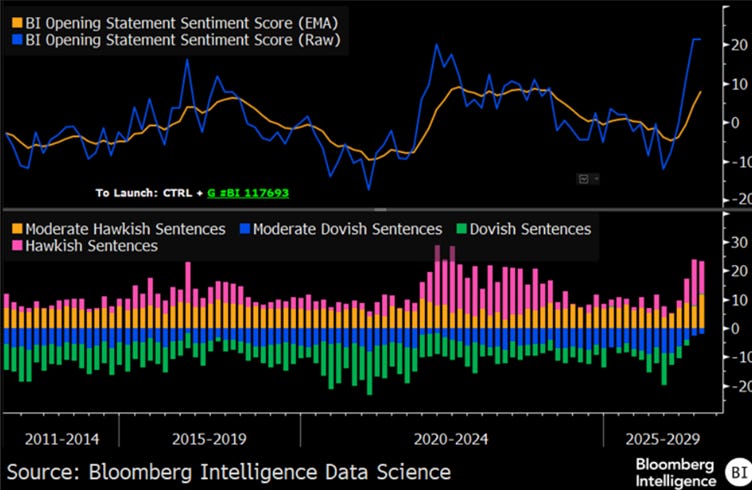
The Bloomberg Fed Sentiment model found Warsh’s remarks hawkish once again. No hike for now—but investors were generously reminded that rate increases remain on the table, because every good central banker likes to leave a loaded gun on the table and call it “optional.”
Market reactions.
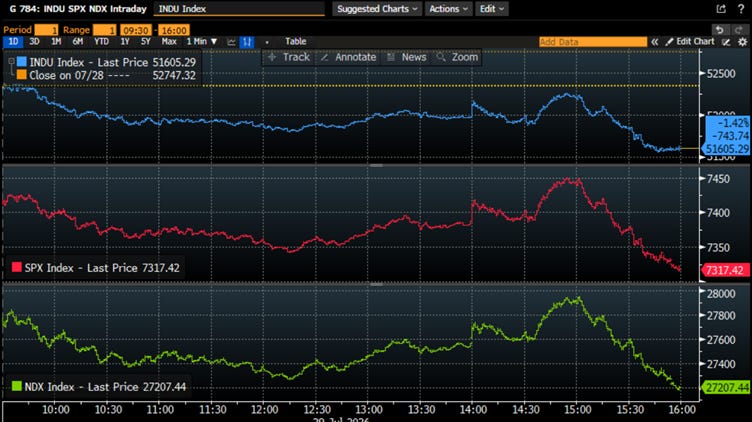
U.S. stocks tumbled after the Fed did exactly what everyone expected—kept rates unchanged—only to remind investors that more hikes remain conveniently “on the table.” Three dissenting votes and Chairman Warsh’s renewed devotion to the sacred 2% inflation target were enough to turn initial optimism into a full-blown selloff. Apparently, nothing rattles markets quite like a central bank insisting it’s both data-dependent and perpetually one meeting away from tightening. Meanwhile, the Iran conflict continues to provide the inflationary backdrop everyone is pretending won’t matter.
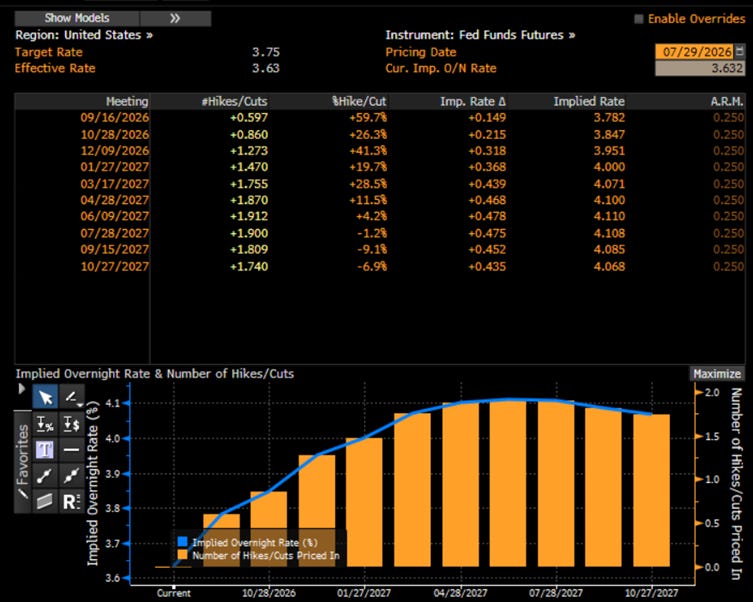
In the money markets, the memo has been received loud and clear: traders are now pricing an 59% probability of a rate hike by September, with a 28% chance of three hikes by December — a remarkable pirouette from the rate-cut fantasyland that dominated positioning just months ago. The market, apparently, has quietly absorbed the unfashionable lesson that wars are inflationary, that oil shocks don’t negotiate, and that a central bank run by a man who says, “inflation is a choice” and then forgets to mention unemployment might actually mean it. The White House, which hired Warsh to deliver cuts, is invited to take a number.
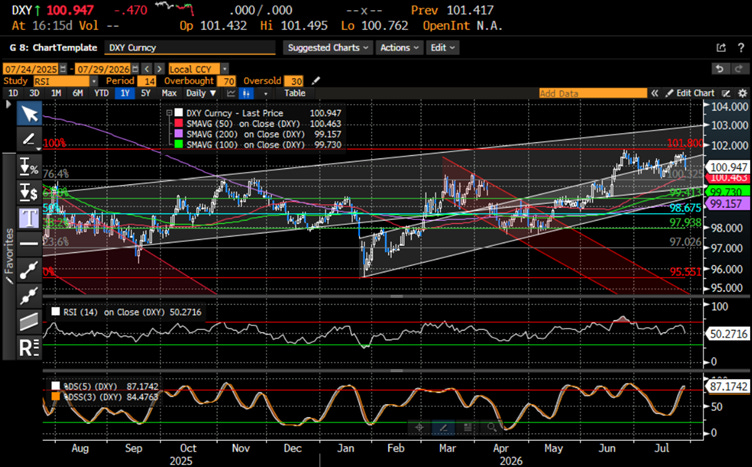
The Dollar Index barely budged as the Fed delivered its now-familiar routine: hold rates steady, sound relentlessly hawkish, and quietly bury the idea of rate cuts next to the soft landing. The message was unmistakable hikes are coming, cuts were yesterday’s fantasy, and anyone still positioned for imminent easing may want to revisit reality. President Trump, who appointed Kevin Warsh to lower rates and build “the greatest machine the world has ever seen,” was, unsurprisingly, unavailable for comment.
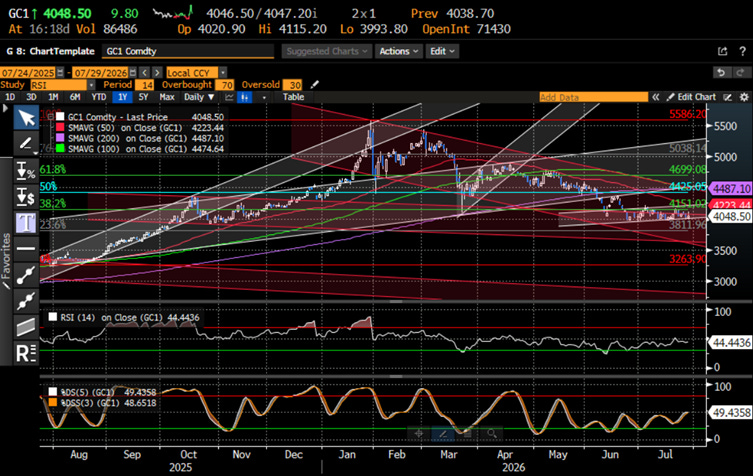
Gold barely reacted to the Fed’s latest hawkish performance. Investors appear to understand what policymakers still struggle to grasp: the more the Fed erodes its credibility, the stronger the investment case for the Eternal Bullion becomes. After all, confidence is the one asset central banks can’t print.
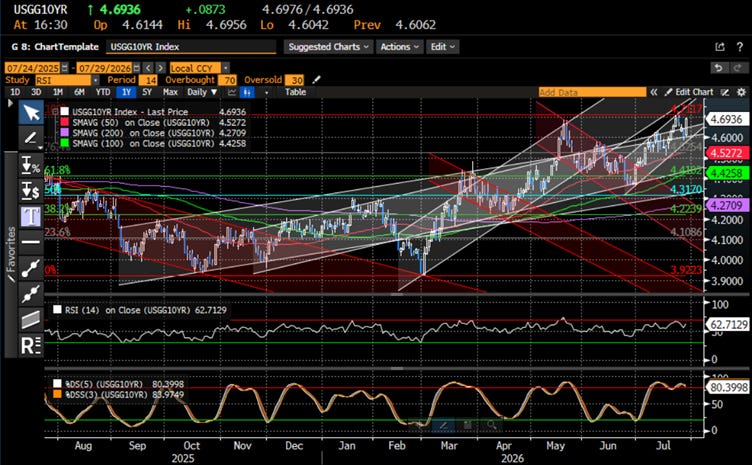
U.S. Treasury yields moved higher as markets continued to price a growing political and inflation risk premium into government debt. In an environment where the White House openly pressures the Fed to ease policy while inflation remains elevated, Treasuries are looking less like a risk-free asset and more like a political instrument. The traditional safe haven increasingly carries two risks: inflation eroding real returns and declining institutional credibility undermining investor confidence. Welcome to the new definition of “risk-free.”
Thoughts.
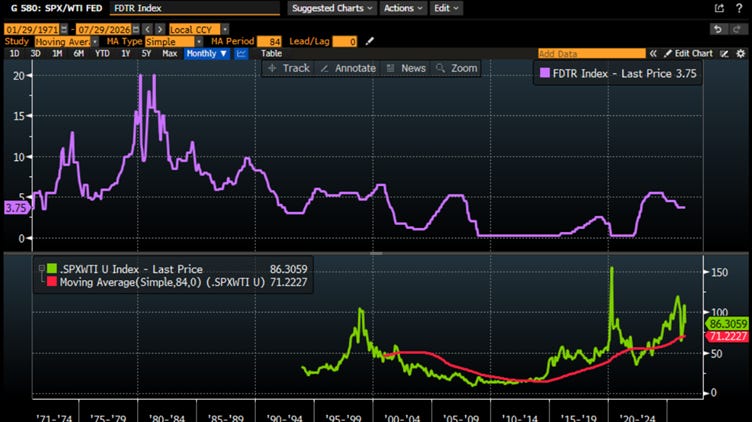
While Wall Street and The Manipulator In Chief continue their favourite magic trick—convincing investors that the Federal Reserve can steer the business cycle—the reality is less enchanting: in every inflationary bust driven by rising oil prices, the Fed has historically been forced to raise rates, not cut them.
FED Fund Rate (purple line); S&P 500 Index to Oil ratio (green line); 7-Year Moving Average of S&P 500 Index to Oil ratio (red line).
Let us begin with the one thing all of Washington agrees on — a phenomenon so rare it should be studied like a comet.
Everybody wants cheap borrowing.
The president wants it because it’s the only growth policy that requires no legislation, no negotiation, and no fingerprints. Cut rates and housing looks affordable on paper, the governments can issue more debt to finance more forever bankers’ wars, and the incumbent gets to pose in front of a green chart. Every president wants this. The Manipulator In Chief merely says it into a microphone with the subtlety of a car alarm. He’s not wrong that lower rates would help him — he’s just fuzzy on who’s holding the dial, and whether the dial is still attached to anything.
Wall Street wants cheap money for reasons so old they’re load-bearing. Modern finance — private equity, buyouts, venture capital, commercial real estate, the whole carnival — is a machine for turning cheap debt into fee income. When money is free, bad businesses look good, good businesses look like miracles, and a mediocre analyst with a spreadsheet and a credit line becomes a titan. Raise the cost of capital and the trick runs backwards: everything bought at three percent has to be refinanced at seven, and the emperor turns out to be not just underdressed but visibly cold. So, Wall Street wants cuts. Wall Street always wants cuts. It wanted cuts at the top of every bubble in history, and it’ll want them at the top of the next one.
And politicians — every party, every era — want cheap money for the most human reason of all: it lets them skip the arithmetic. Borrow cheaply enough and you never have to choose between guns and butter. You can have both, plus dessert, plus a war, plus a tax cut, and mail the bill to a future that can’t vote yet. No one has ever campaigned on higher rates and painful restraint, and no one ever will, because that candidate loses to a golden retriever promising treats.
So, the constituency for lower rates is the president, all of Wall Street, and every elected official in the country. A formidable coalition. Nearly everyone with power, in fact.
And it doesn’t matter.
This is the part most people get wrong. Wanting cheap money is universal, bipartisan, and completely unrelated to whether cheap money is safe. It isn’t an economic argument. It’s an appetite. And the Fed — whatever its many sins — doesn’t exist to feed appetites when the tab is a currency crisis.
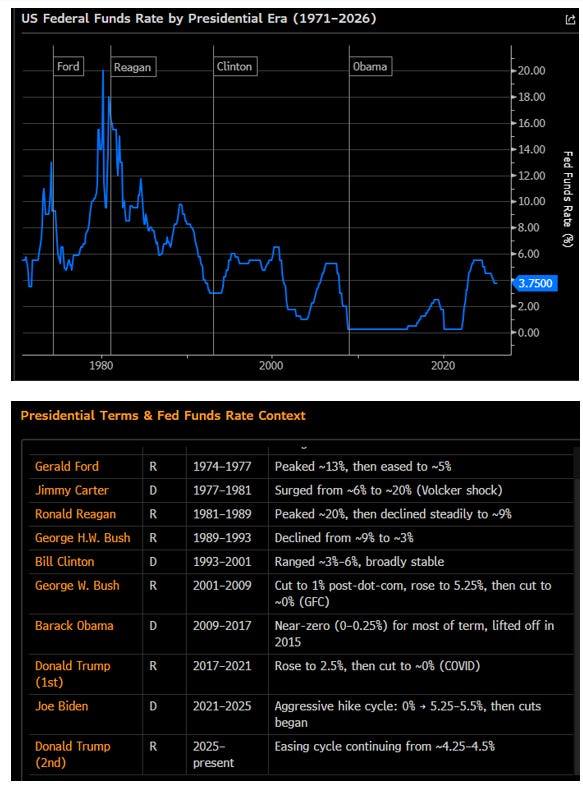
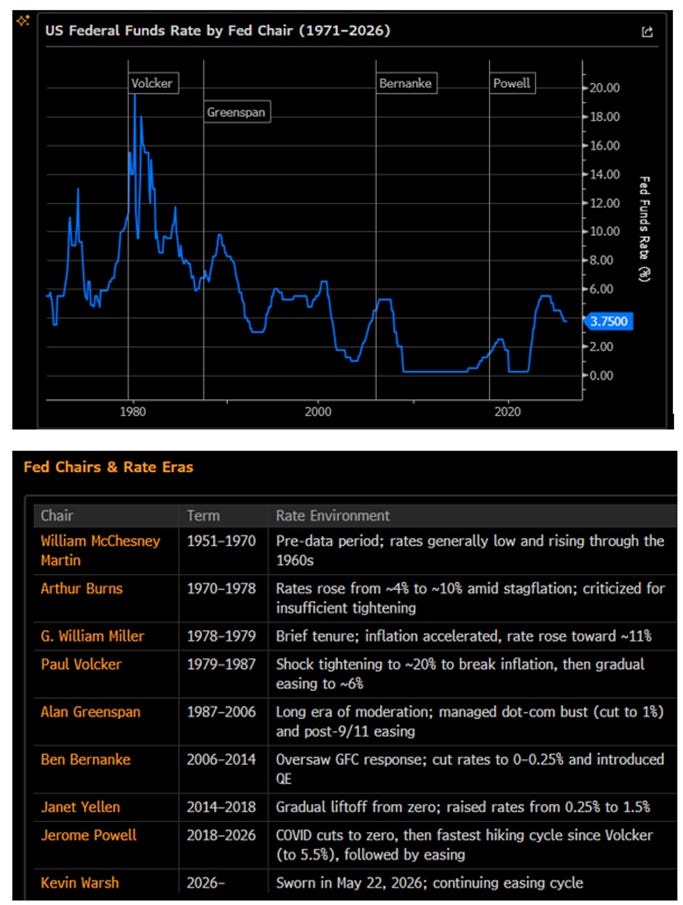
It helps to remember that the Federal Reserve has never controlled the cycle, but the cycle has always controlled the FED. The FED has always been, at heart, a very expensive relay race in which each runner is handed the baton, a smouldering economy, and the previous runner’s mistakes. William McChesney Martin set the tone by famously taking away the punch bubbly just as the party got good — a trick none of his successors could reliably repeat. Arthur Burns then spent the 1970s watching rates climb from four to ten percent while being scolded for not climbing them faster, a special kind of humiliation. Poor G. William Miller lasted barely a year, long enough to preside over inflation marching toward eleven percent and to be quietly reassigned before anyone noticed. Then came Paul Volcker, six-foot-seven and utterly unbothered, who cranked rates to twenty percent, broke inflation over his knee, and made every chairman since terrified of being remembered as the one who didn’t. Greenspan turned central banking into interpretive jazz for two decades; Bernanke discovered that rates have a floor of zero and a basement called “QE”; Yellen gingerly tiptoed off that floor; and Powell ran the fastest hiking cycle since Volcker, cut, and then handed the baton along. Which brings us, in May 2026, to Kevin Warsh — inheriting a “continuing easing cycle,” a mountain of debt, and the quiet expectation that he’ll keep the party going. The table lists him under “easing.” The Butler suspects the table may need an eraser.
To see why the Fed is trapped, look at the equipment it carries into battle — because a soldier with one weapon will use that weapon whether or not the situation calls for it.
The Federal Reserve, like nearly every central bank on earth, runs on Keynesian demand management. That’s not an insult, just a description. The whole toolkit assumes inflation is a demand story — too many dollars chasing too few goods — so the cure is to make money expensive until people stop spending. Raise rates, cool the economy, prices settle. It’s elegant. It fits on a napkin. It has a graph where two lines cross. And for inflation that comes from a genuinely overheating economy, it even works.
The trouble is it’s the only model they have. And when your only tool suppresses demand, every inflation on earth starts to look like a demand problem — the way a man holding a hammer develops strong opinions about the nail-like qualities of his surroundings.
This is the intellectual cage inside the political one. Suppose inflation reaccelerates in late 2026 — and there are a dozen reasons it might. What can the Warsh Fed actually do? Raise rates. That’s the move. That’s the whole move. It can’t repeal a tariff, end a war, or un-borrow four trillion dollars. It can’t conjure a semiconductor factory in Arizona, refill a strategic reserve, negotiate with OPEC, or talk a contested shipping lane down off the ledge. It can raise the price of money and hope that squeezing domestic demand hard enough drags the headline number toward two percent — even when the actual fire is burning somewhere the interest rate can’t reach.
WTI Price (blue line); FED Fund Rate (red line).
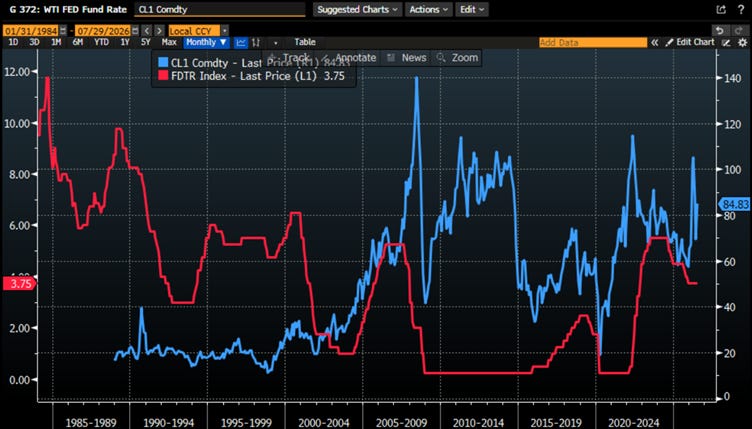
And here’s the troubling part: Warsh will do it. Not because he’s foolish — he may be the most serious chairman in a generation — but because he believes in the institution’s credibility above all, and raising rates is the one gesture that proves the Fed means it to the only audience that counts: the bond market. A dove flinches. Warsh won’t. He spent fifteen years as the man warning about debasement; he didn’t take the job to preside over its confirmation. If prices run, he tightens — straight into the teeth of the president who appointed him, a Wall Street that will despise him for it, and a Congress that will haul him before cameras to explain why he is personally strangling the American Dream.
That’s the trap. But notice its shape. It isn’t that Warsh lacks the nerve to raise rates. It’s that raising rates may be the wrong medicine for the disease — and it’s the only bottle in the cabinet.
Keep reading with a 7-day free trial
Subscribe to The Macro Butler’s Substack to keep reading this post and get 7 days of free access to the full post archives.