

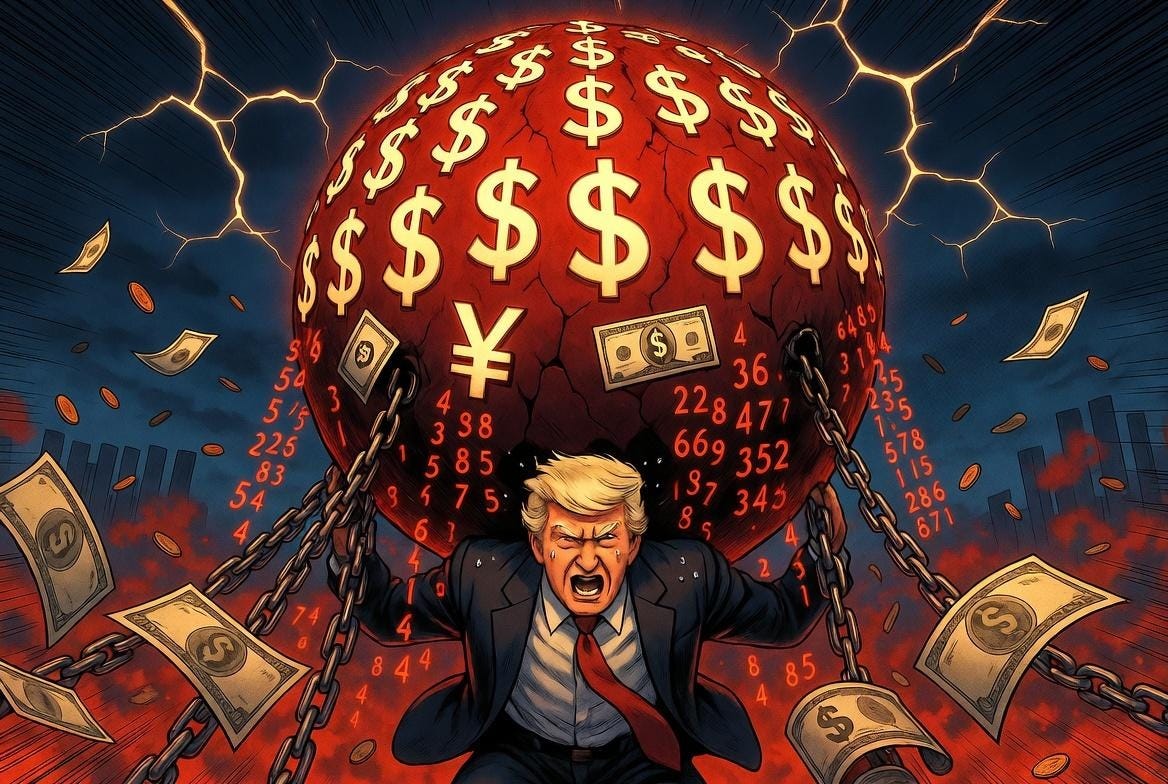
The Week That It Was…
The first week of Q3’s second month arrived with the reliable punctuality of a data calendar nobody requested but everyone endured: a global PMI parade — China Manufacturing and Services, US Manufacturing and Non-Manufacturing ISM, and the forever-misinterpreted Non-farm Payrolls — alongside the US and China Trade Balances. The real entertainment arrived in a heavyweight earnings week: 136 S&P 500 companies reported, headlined by Palantir, Berkshire Hathaway, AMD, Arista Networks, and Caterpillar. The supporting cast read like a shopping list — Devon Energy, Occidental, EOG, and Texas Pacific Land for the war-cycle energy thesis; Glencore for the commodity Supercycle; Wheaton Precious Metals for the Eternal Bullion; and Kratos Defence for the drone-warfare boom.
The Ministry of Strategic Diplomacy keeps following its official four-phase negotiation methodology, rendered as a circular flowchart for the benefit of allies, adversaries, and confused bond traders alike: Phase One, “We’re going to bomb their power plants“; Phase Two, “They called us begging for a deal“; Phase Three, “They’re giving us everything we want“; and Phase Four, “They’re scum, you can’t negotiate with these people“ — after which the cycle returns seamlessly to bombing power plants, having resolved precisely nothing while consuming a strategic petroleum reserve, closing two shipping chokepoints, and whatever credibility remained.

The genius of the diagram is its honesty: there is no exit node, no “peace achieved,” no “conflict resolved” — merely an eternal loop in which each phase is announced with total conviction via Truth Social, believed by markets for approximately 48 hours, and then contradicted by the next phase with equal conviction.
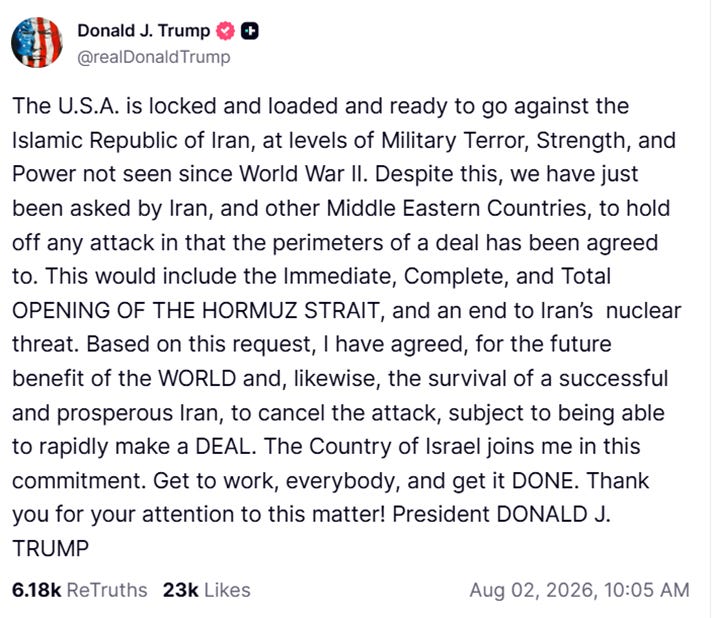
https://truthsocial.com/@realDonaldTrump/posts/117023461141824050
The “You are here” arrow, pointing at Phase Two, is the only fixed coordinate in an otherwise infinite rotation — a reminder that whichever soothing headline is currently calming the oil market, the return to Phase One is never more than one social media post away. The Iran ceasefire completed this cycle four times in five weeks.

The negotiation cycle has no destination because the process is the destination — bomb, deal, betrayal, repeat, and bill the taxpayer for each rotation.
The Ministry of Defensive Operations has issued a routine agricultural clarification: according to formal complaints Lebanon has lodged with the United Nations, Israel sprayed the toxic herbicide glyphosate across an 18-kilometre strip of southern Lebanese farmland in February 2026, at soil concentrations of 22,750-23,000 micrograms per gram — over 11,000 times the level of routine agricultural use — in an operation Lebanese officials describe as designed to render the land “empty of any life.” The Ministry prefers the term “buffer zone“ to the term “scorched earth,” though the distinction is lost on the 76% of farmers displaced from affected areas, the 22-24% of Lebanon’s cultivated land now damaged, and the citrus and banana groves that produce up to 97% of the region’s fruit and will not recover within a generation. Satanyahu’s tactic is not new — the Scythians used it against Darius in 513 BC, Rome salted Carthage’s soil in 146 BC, and the Taliban poisoned the wells of the Shomali Plain in 1999 — but each historical precedent shares a defining feature the modern version has faithfully preserved: the target was never the army, it was the population’s ability to ever live there again.

The Ministry of Public Necessity has issued a clarifying update on private property rights: American families may now have their land seized under eminent domain to construct transmission lines for AI data centres, provided the project is declared a “public use” and the owner receives what the government generously calls “just compensation” — a phrase doing considerable work when the actual beneficiary is an unnamed technology corporation whose identity is protected by “customer confidentiality” while the landowner is protected by nothing at all.
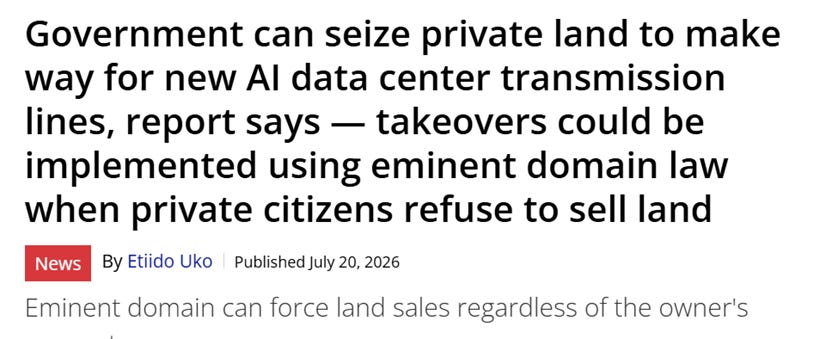
Georgia Power has already acquired over 300 parcels for a transmission project it admits is 70-80% dedicated to data-centre demand, informing families that refusal would trigger condemnation, and declining to name which trillion-dollar tech company would inherit the electricity flowing across their expropriated land. The United States hosts 3,000 data centres with 1,500 more under construction, consuming over 4% of national electricity, and 70% of Americans oppose having one built near them — a democratic sentiment the state has elegantly resolved by simply overriding it, because the Fifth Amendment’s “public use“ clause was quietly redefined after Kelo v. New London to mean “any private commercial project we prefer.” The citizen retains one right unambiguously: to pay property taxes on land he occupies only until a politically connected corporation wants the ground beneath it.
That is not capitalism. It is corporatism enforced by the state, and eminent domain is the weapon that makes the robbery legal.
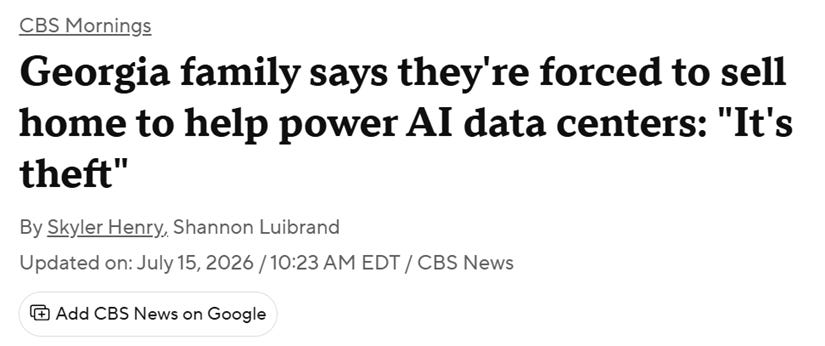
https://www.cbsnews.com/news/georgia-power-ai-data-centers-eminent-domain/
The Ministry of Making America Healthy Again has unveiled its latest wellness initiative: the EPA has approved two new fluorinated pesticides — diflufenican and epyrifenacil — for use on corn, soybeans, and wheat, the three crops that form the backbone of the American food supply, neither of which had ever previously been permitted on US farmland. Environmental scientists classify both as PFAS “forever chemicals” that degrade into trifluoroacetic acid, an extraordinarily persistent compound already contaminating groundwater worldwide; the EPA disputes this classification with the serene confidence of a regulator that has decided the definition it prefers is the one that matters. The delicious contradiction writes itself: the same administration whose Health Secretary has built an entire “Make America Healthy Again” campaign around eliminating food dyes, reforming ingredients, and reducing chemical exposure has simultaneously approved brand-new forever chemicals for the nation’s staple crops — Denmark banned diflufenican over groundwater contamination, the EU never approved epyrifenacil at all, but American consumers are expected to assume the science is settled and the debate is closed. Food security has always been national security, and once trust in the food supply erodes, it does not return with a press release.
When the government eliminating chemicals from your food is the same government adding new forever chemicals to your wheat, “Make America Healthy Again” was never a policy — it was a slogan with an asterisk.

The Ministry of Public Health Innovation has identified its next revenue opportunity: Moderna is back at the public trough with an experimental mRNA vaccine targeting the Bundibugyo strain of Ebola, with Health Canada authorising a Phase 1 trial in about 80 adults across three sites — in a country that has never recorded a single Ebola case and whose own government admits the risk to the general population is low, because healthy Canadians make excellent unpaid human data for a product destined for a third-world African market. The financial architecture is a masterpiece of privatised reward and socialised risk: the Coalition for Epidemic Preparedness Innovations has pledged up to $50 million for preclinical research, Phase 1 testing, and manufacturing doses before the trial even concludes — meaning if the product fails, outside funding absorbs the loss, and if it succeeds, Moderna keeps a proprietary vaccine that governments will purchase at an undisclosed “access price” paid by undisclosed parties. The timing is not coincidental: Moderna just reported a $782 million quarterly loss, its norovirus and cytomegalovirus vaccines failed their endpoints, and the FDA refused to review its flu-vaccine application — so the COVID goldmine’s exhaustion requires a fresh pathogen to convert into a government-backed revenue stream.

https://www.cbc.ca/news/health/ebola-vaccine-trial-health-canada-moderna-9.7295616
The Ministry of Preemptive Absolution has encountered an unexpected jurisdictional inconvenience: Sleepy Joe’s autopen granted ‘Jekyll Fauci’ a “full and unconditional pardon” for any federal offenses committed between January 1, 2014, and January 19, 2025 — an eleven-year shield beginning, with impeccable coincidence, precisely when the EcoHealth Alliance grant period involving bat-coronavirus research at the Wuhan Institute of Virology commenced, and issued while simultaneously insisting Fauci had committed no crime, because nothing says “innocent” quite like a preemptive decade-spanning pardon for offenses nobody will specify. The architecture of the shield, however, has a flaw the political class prefers not to mention: a president may pardon “Offences against the United States” — federal crimes — but cannot repeal a Florida, Texas, or Missouri statute, terminate a state investigation, or immunize conduct occurring after January 19, 2025.
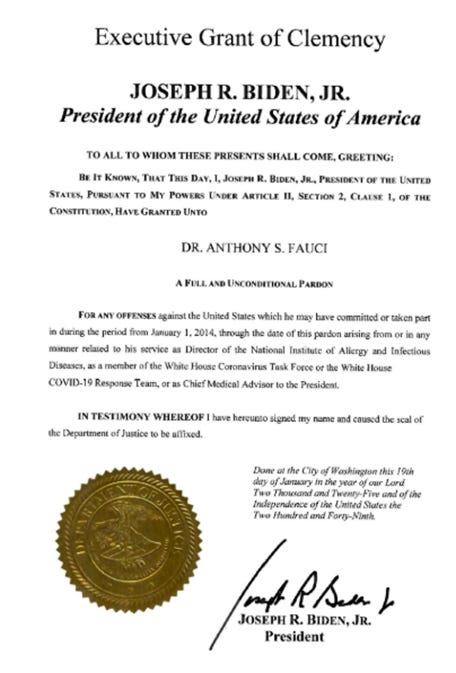
The Ministry of Public Health has issued its final clarification on the pandemic accountability question: the citizens who were locked down, censored, threatened with unemployment, separated from dying relatives, and treated as criminals for asking questions are now respectfully informed that the officials who imposed all of it are entitled to pardons, lawyers, and constitutional protections — the very protections those officials showed no interest in extending to anyone else when ordinary citizens needed them. The doctrine of “trust the science,” which functioned throughout the pandemic as a political loyalty oath enforced by censorship and mandate, has now been quietly retired and replaced with its inverse: the right to remain silent, invoked 111 times under oath by the same man who once insisted that questioning him was questioning science itself. The architecture is elegantly complete — blind obedience demanded from below, due process discovered from above, and a decade-spanning pardon issued preemptively for crimes nobody is permitted to specify.

The Ministry of Sustainable Resource Management has declared 2026 the “Year of Water” and unveiled “Blue Davos” — the World Economic Forum’s ambitious initiative to bring freshwater, ocean policy, food security, and the “blue economy” together under one institutional umbrella, promising to “manage” access to the one resource on Earth that no human being can opt out of consuming. The rebrand from green to blue is instructive: the same organisations that spent a decade lecturing the world about carbon are now speaking of basin-level partnerships, water finance, private-sector participation, and “scalable systems of allocation” — and whenever unelected bodies insist a crisis requires policies to be “scaled rapidly,” the only sensible questions are who acquires the power, who provides the capital, and who controls the infrastructure once the emergency conveniently never ends.

The symbolism is almost too perfect: when Klaus Schwab resigned in 2025, the Forum’s board appointed as interim chairman Peter Brabeck-Letmathe, the former Nestlé CEO who once argued that water should be treated as a priced commodity rather than a human right. AI has now supplied the flawless pretext — data centres consuming water through evaporation — even as engineers holding patents for waterless cooling quietly demonstrate the scarcity narrative is more useful than accurate. The water wars won’t begin with soldiers at a river — they’ll begin with permits, meters, tiered pricing, and public-private agreements nobody reads, until the government no longer needs to seize your land because it controls whether the land gets water.
The Ministry of Global Fairness has unveiled its most ambitious redistribution project yet: a UN proposal to replace the current system of taxing multinational subsidiaries with a “global unitary tax,” combining a corporation’s worldwide profits into one pool and reallocating them by formula — a scheme the Tax Justice Network promises will conjure $500 billion in additional annual revenue from nowhere, which is the globalist way of describing the transfer of taxing rights from sovereign nations to a formula designed in New York. The losers are precisely the jurisdictions that built competitive economic models the bureaucracy finds objectionable: Ireland surrenders 81.9% of its multinational tax base, Hong Kong 75.7%, Singapore 69.2%, Switzerland 42%, and Japan a staggering $34 billion — with the UN helpfully suggesting these nations could recover the losses by raising effective rates to levels between 68% and, in the case of the British Virgin Islands, 643%, an “admission” that the model cannot survive its own prescription. The proposal explicitly covers “all types of taxes with transboundary effects,” meaning once the machinery exists, it expands into wealth taxes, digital taxes, environmental taxes, and the taxation of mobile individuals — because the bureaucracy’s only product is more bureaucracy, and every failure becomes the justification for its own expansion.

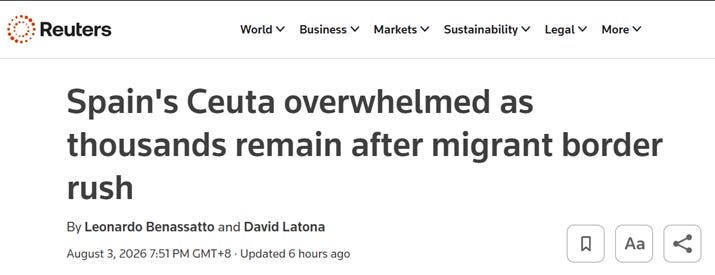
The Ministry of Compassionate Governance has delivered a masterclass in engineering a crisis and then denouncing it: the Spanish government issued a sweeping royal decree to legalise hundreds of thousands of undocumented migrants, bypassed Parliament entirely, and then expressed astonishment when the rest of the world interpreted the message exactly as any rational person would — enter illegally today, get legalised tomorrow.
Approximately 60,000 migrants poured into Ceuta in roughly 24 hours — a city of 85,000 residents — swelling its population by 70% overnight, with at least 57 people dead from drowning and stampedes, and the child-protection system operating at 1,600% of capacity. Sánchez, having promoted himself as Europe’s humanitarian alternative, suddenly rediscovered that a nation requires borders, deployed the military, and returned 48,000-70,000 migrants within days — thereby proving he possessed the capability to defend the border all along and simply declined to exercise it until the shops closed, the streets filled, and voters began asking who was in charge. The migrants, encouraged by rumours, court rulings, and Madrid’s own signals to risk drowning, were then expelled once reality destroyed the performance.
The Ministry of Shared Sacrifice has published its latest polling data, which reveals a remarkable pattern of generational altruism: support for mandatory military service reached 62% in France, 53% in Germany, and 51% in Poland — but when the German figures are disaggregated by age, net opposition among those aged 18 to 29 hit 46%, while net support among respondents over 70 stood at 49%, confirming that the demographic most enthusiastic about war is precisely the one guaranteed never to fight it. The elegance of the arrangement is total: those safely beyond military age will never receive the draft notice, surrender their careers, or be ordered into a trench — they will watch the war on television while congratulating themselves for supporting “national service” as though clicking “yes” in a poll were an act of personal courage. The same political establishment that dismantled Europe’s industrial base, destroyed affordable energy, accumulated mountains of sovereign debt, and refused every opportunity for serious diplomacy now demands that a generation with no voice in those decisions be prepared to die defending the order that bequeathed it unaffordable housing, stagnant wages, and crushing taxation. The children of the connected will find deferments; the working class will supply the bodies, as always.

The same political establishment that dismantled Europe’s industrial base, destroyed affordable energy, accumulated mountains of sovereign debt, and refused every opportunity for serious diplomacy now demands that a generation with no voice in those decisions be prepared to die defending the order that bequeathed it unaffordable housing, stagnant wages, and crushing taxation. The children of the connected will find deferments; the working class will supply the bodies, as always.

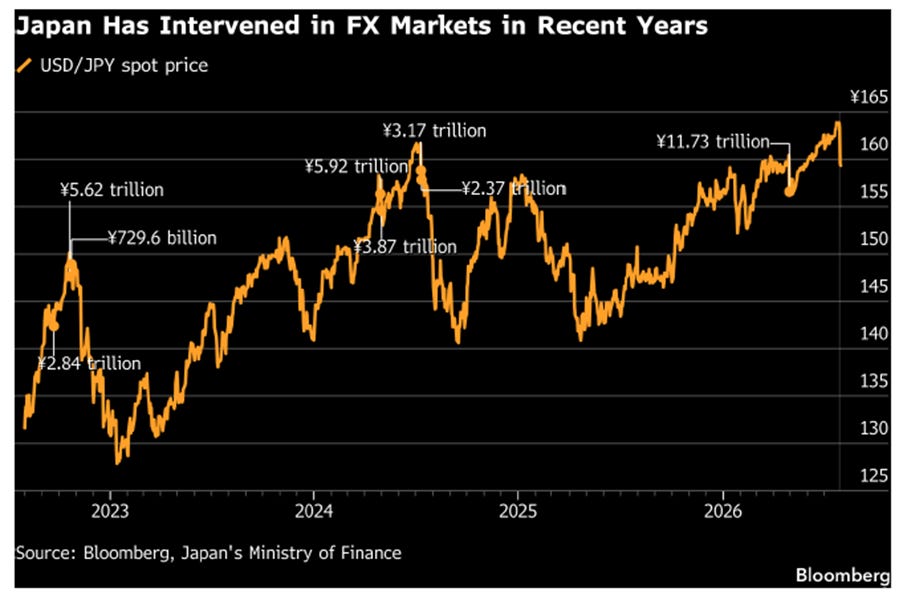
The Ministry of Free Markets has unveiled its most candid policy document yet: a handwritten notepad, photographed at a Camp David cabinet meeting and helpfully published by Reuters, reading under a “To Do” heading — “Buy Japanese Yen (JPY) $5-10 bil” — in the confident penmanship of a US Treasury Secretary who apparently believes currency intervention should be conducted with the same discretion as a grocery list. Scrooge Bessent, drawing on his hedge fund career and his newly discovered conviction that the yen is “too weak,” has joined Tokyo in engineering the yen’s rebound from 162 — its weakest since 1986 — to 157.40, in what officials are describing as the tightest US-Japan currency coordination in decades and everyone else recognises as two governments intervening in a free market to fix a price they don’t like.


Japan spent a record ¥8.45 trillion ($52.8 billion) in a single day, the New York Fed sold euros to buy yen on the Treasury’s behalf, and the same administration that lectures the world about market forces is now buying currencies by the billion while the BOJ holds rates at 1% against the US’s 3.75% — the actual cause of the weakness that no amount of coordinated intervention can paper over.
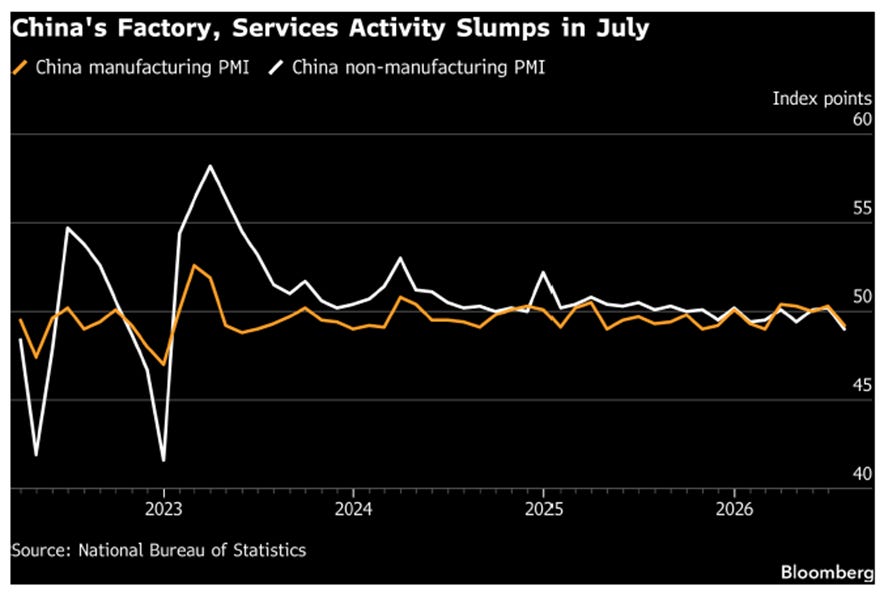
An economy that spent June celebrating its factory PMI crawling above 50 has now watched it slither back below in July, proving once again that in China’s data, the difference between expansion and contraction is roughly the width of a statistician’s optimism. The official manufacturing PMI slipped to 49.2 — below the 50 threshold, missing every single estimate in the Bloomberg survey — while the non-manufacturing measure retreated to 49, its lowest since December 2022, and the construction PMI plummeted to a genuinely alarming 47, confirming that the property sector remains in the condition of a patient whose doctors have stopped using the word “recovery” and started using the word “comfortable.”
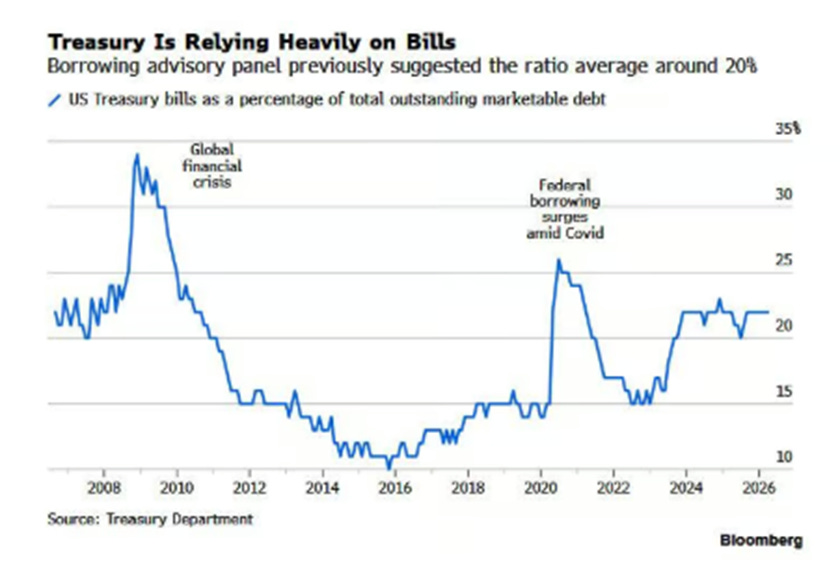
The Treasury’s Quarterly Refunding once again delivered the market’s favourite kind of news — no news at all — retaining auction sizes well into 2027 with the same market-soothing “for at least the next several quarters” language it has recycled faithfully since Janet Yellen’s Activist Treasury Issuance days, because nothing calms a bond market quite like a Treasury Secretary pretending nothing is happening. What is actually happening, however, is that Scrooge Bessent is deepening the government’s reliance on short-term T-bills in a strategy dealers have affectionately dubbed “T-bill and chill” — the fiscal equivalent of paying your mortgage with a series of increasingly frantic payday loans and calling it a liquidity strategy.
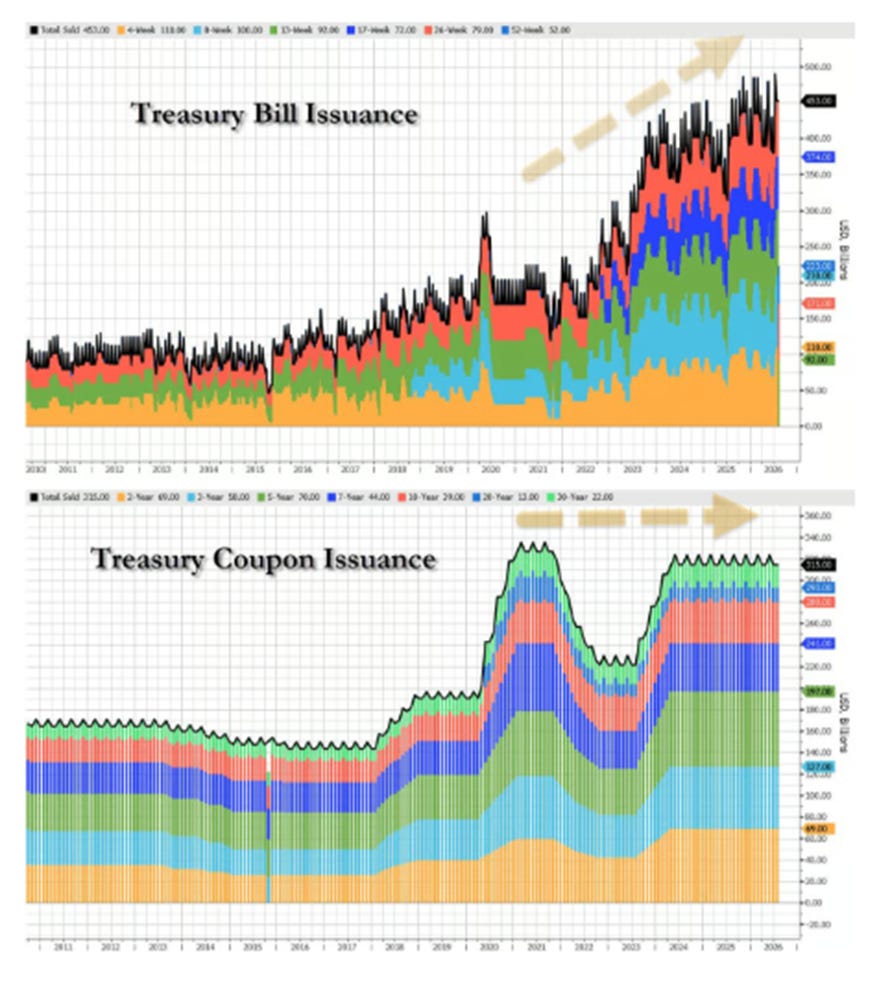
The bill-to-debt ratio is now historically high, borrowing needs swelled to $739 billion for the quarter, and total US debt hits $40 trillion in two weeks — yet the Treasury declines to increase longer-dated coupon issuance because 10-year yields just hit their highest since Bessent took office, and issuing more long bonds at those yields would be embarrassing. Some strategists link the reluctance to the looming November midterms, because engineering a market melt-up until the election is considerably more urgent than fiscal sustainability.
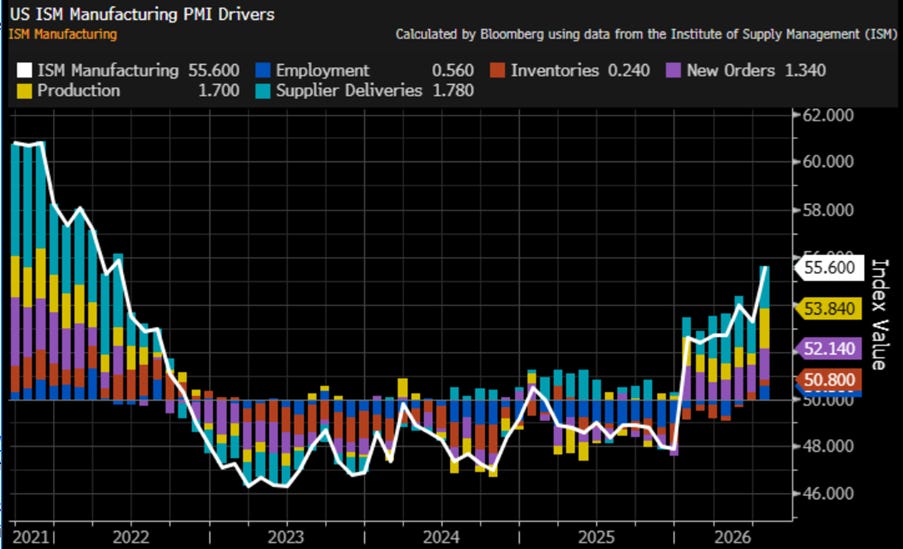
July’s US manufacturing data offered investors the customary choose-your-own-adventure: the ISM survey surged to 55.6 — its strongest since May 2022 — with inflation lower, orders higher, and employment beating expectations, while S&P Global’s competing PMI flatlined at 53.9 near three-month lows, meaning the same economy is simultaneously booming and stalling depending entirely on which analyst you prefer to believe. Beneath the survey there are some warning signs about the future growth trajectory — namely production growth slowing for a third month, supply chain delays intensifying to their sharpest deterioration in four years, exports falling, customers pushing back on high prices, and the Q2 precautionary stockpiling binge fading exactly as predicted. Input costs remained elevated thanks to high energy prices, producers kept raising factory gate prices to protect margins, and business optimism about growth slipped to its lowest since last October — a constellation of stagflationary tells that the ISM headline number cheerfully ignored.
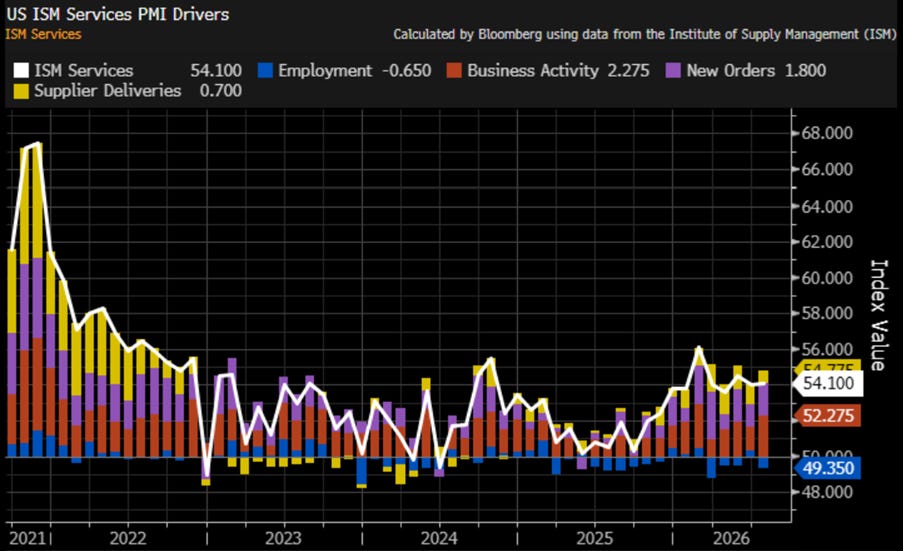
July’s services data delivered the market’s favourite genre of good news: the kind that dissolves the moment you read the second paragraph. S&P Global’s Services PMI leapt to 54.6 — its highest since October 2025 and biggest monthly jump since May 2024 — with business confidence surging, new work hitting a 19-month high, and private sector employment finally rising for the first time since April, prompting the customary declaration that the economy is accelerating into Q3. Then the fine print arrives to spoil the party like a chaperone at a school dance: the improvement “partly reflected temporary factors,” with the biggest demand surge coming from consumer-facing services thanks to — wait for it — the FIFA World Cup and US Independence Day celebrations, meaning America’s economic renaissance was substantially powered by soccer fans and hot dogs. The ISM survey, meanwhile, showed employment tumbling back into contraction at 47.4, prices paid jumping to a scorching 70.3, and the whole thing flashing what the analysts delicately termed “a somewhat stagflationary signal.” The tailwind of “reduced geopolitical uncertainty and lower oil prices” that boosted early July has since reversed entirely as the Gulf reignited.
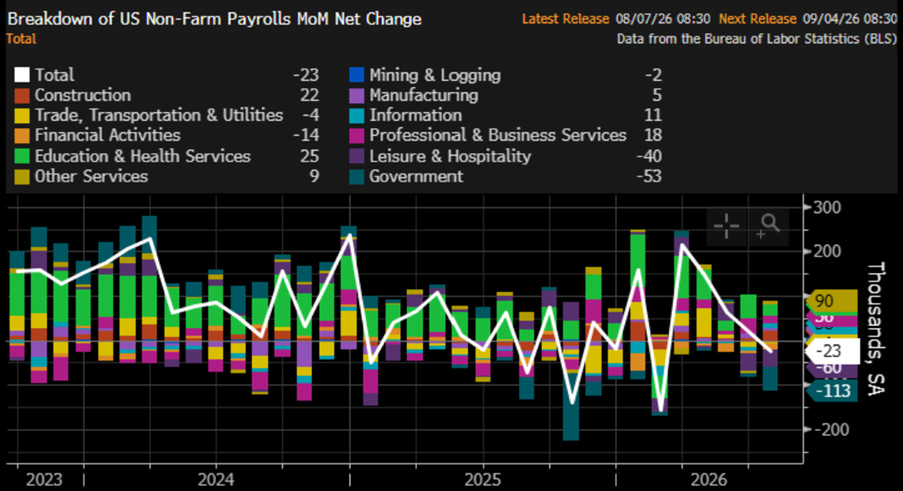
July’s jobs report delivered the market’s favourite genre of statistical comedy: the US economy actually lost 23,000 workers — below every single estimate on Wall Street, a 5-sigma miss so far outside the range that the 80,000 median forecast was off by more than 100,000 — while the unemployment rate somehow declined from 4.2% to 4.1%, achieved through the elegant mechanism of 178,000 people simply vanishing from the labour force faster than the 87,000 who lost their jobs, because in modern American statistics, the fastest route to a lower unemployment rate is convincing people to stop looking for work entirely. The revisions arrived precisely on schedule: May was slashed by 66,000 and June by 37,000, erasing 103,000 jobs that were previously celebrated as evidence of a resilient consumer, confirming that the “strong labour market” of prior months was a rough draft awaiting correction. Average hourly earnings rose a threadbare 0.1% — half the expected pace — dragging annual wage growth to 3.2% and confirming that Americans are simultaneously losing jobs and earning less on the ones they keep, which is the stagflationary double-feature the consensus keeps forgetting to buy a ticket for.
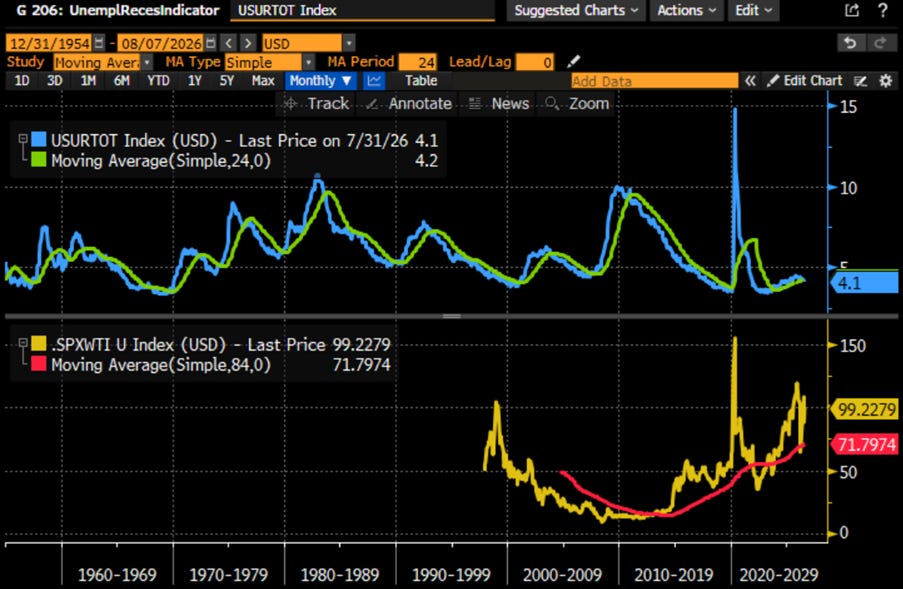
As always, the chart tells the story the headline won’t: the unemployment rate “fell” to 4.1% not because Americans found jobs but because they stopped looking — a diet declared successful by throwing out the scale. Meanwhile the real drama is that the geopolitical premium the consensus swore was “erased” has come roaring back. Every time unemployment ticked up from a cycle low while oil spiked simultaneously — 1973, 1979, 1990, 2008 — the economy learned that “stagflation“ and “soft landing” are not synonyms, no matter how creatively the participation rate is massaged.
Upper Panel: US Unemployment Rate (blue line); US Unemployment 2-Year moving average (green line); Lower Panel: S&P 500 to WTI ratio (yellow line); US S&P 500 to WTI Ratio 7-Year moving average (red line).
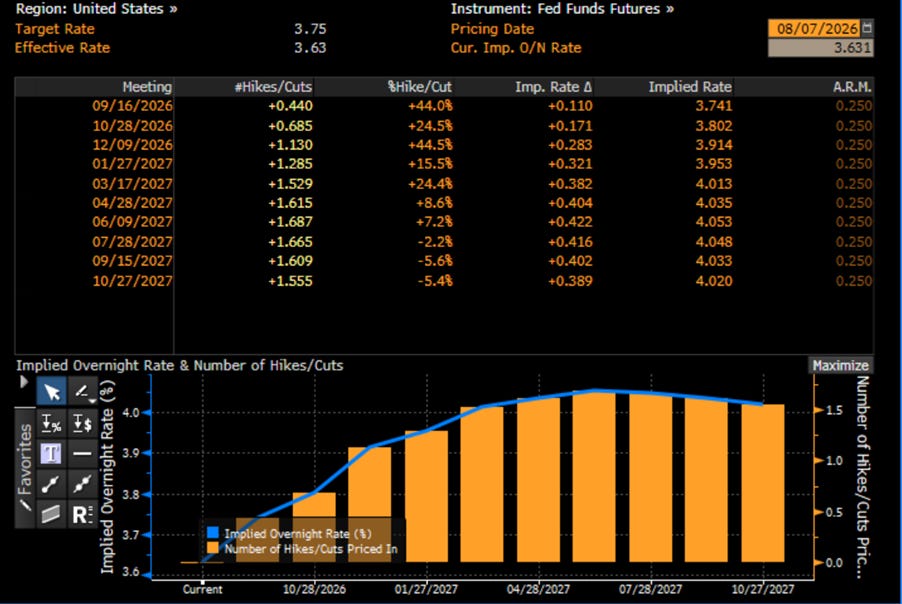
After a non-farm payroll release that merely confirmed what everyone not residing in the Washington swamp already knew — that the labour market is contracting, wages are stalling, and the “resilient consumer” was a rough draft awaiting downward revision — Wall Street’s endlessly imaginative EYIs have executed yet another graceful pivot, this time postponing the inevitable rate hike from September to October, pricing in one hike by October with 68% probability and two by year-end at a timid 13%. This is, of course, the same consensus that spent the entire first half of 2026 pricing in rate cuts with the unshakeable conviction of men who had been handed the script, memorised their lines, and then watched the director rewrite the entire plot — and who now respond to each contradiction not with humility but with a fresh forecast delivered at the same volume. The foundational truth they continue to resist is simple: the Fed doesn’t control the cycle — the cycle controls the Fed — and the bond market set this rate path months ago while the FOMC was still discussing the possibility of cuts. The Fed, true to form, remains the passenger in seat 32B, occasionally leaning forward to ask what altitude they’re flying at and being handed a laminated card about price stability, while the bond market does the actual flying, sets the actual course, and lands the actual plane — then waits politely for the Fed’s press conference to announce the destination everyone already reached.
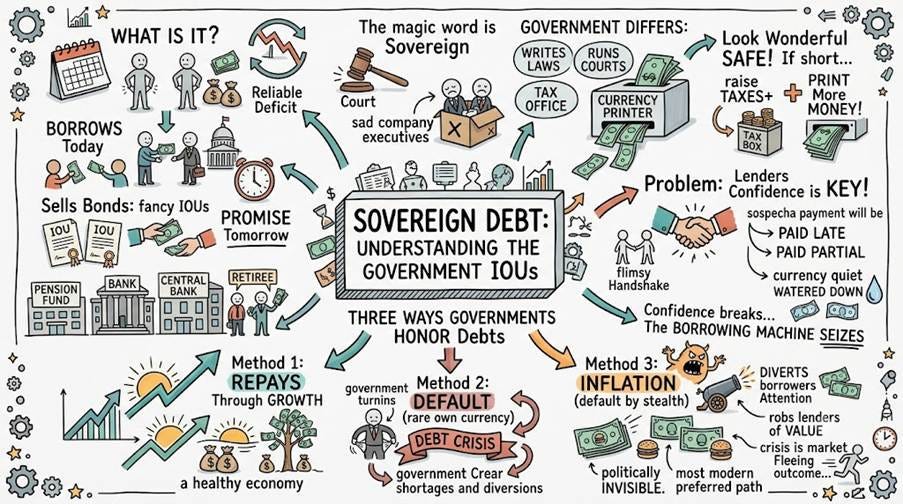
Sovereign debt is just a government borrowing money because it spent more than it collected — which, let’s be honest, describes almost every government, every year, with the reliability of a hangover. To cover the gap, it sells bonds: fancy IOUs promising to pay you back later, with a little interest for your patience. Pension funds, banks, central banks, and retirees all line up to hand over cash today for a promise about tomorrow. What could possibly go wrong?
The magic word is “sovereign.” A company that can’t pay gets hauled into bankruptcy court, stripped for parts, its executives escorted out with a sad cardboard box. A government can’t. It writes the laws, runs the courts, commands the tax office, and — crucially — owns the currency printer. That’s what made government debt look so wonderfully safe: if it runs short, it can raise your taxes, and if that fails, it can simply print more of the stuff it owes you. Unbeatable, really.
Which is exactly the problem. Since no court can force a government to pay, the whole arrangement rests on something flimsier than a contract: confidence. Lenders play along as long as they believe they’ll be repaid in money that’s still worth something. But the day they start to suspect they’ll be paid late, paid partially, or paid in currency quietly watered down to homeopathic strength — that’s the day the music stops, the borrowing machine seizes up, and everyone remembers that an IOU is only as good as the person who wrote it.
There are really only three ways a government can honour its debts, and understanding them is the key to everything that follows. The first is the honest way: it runs a healthy economy, collects rising tax revenue, and pays lenders back in sound money. This is repayment through genuine growth.
The second is default — the government simply refuses to pay in full, restructuring or writing down what it owes. This is what we normally call a debt crisis, and it is rare among large economies that borrow in their own currency, because a third option is almost always available first.
That third option is inflation — the government creates shortages and bombs its neighbours to divert the attention of its borrowers. It repays the bond in full, in nominal terms, but in currency that buys far less than it did. The lender is repaid the number written on the bond but robbed of its value. This is default by stealth, and it is the path most modern governments quietly prefer, because it is politically invisible in a way that an outright default never is. A crisis, when it comes, is usually the market’s attempt to price in which of these three outcomes is coming — and to flee before it arrives.
Sovereign debt crises feel like a modern invention — something cooked up by central bankers, spreadsheets, and men who say “quantitative easing” without laughing. They’re not. This particular disease is ancient. It’s buried every empire that was absolutely certain it was the exception — and they were all certain.

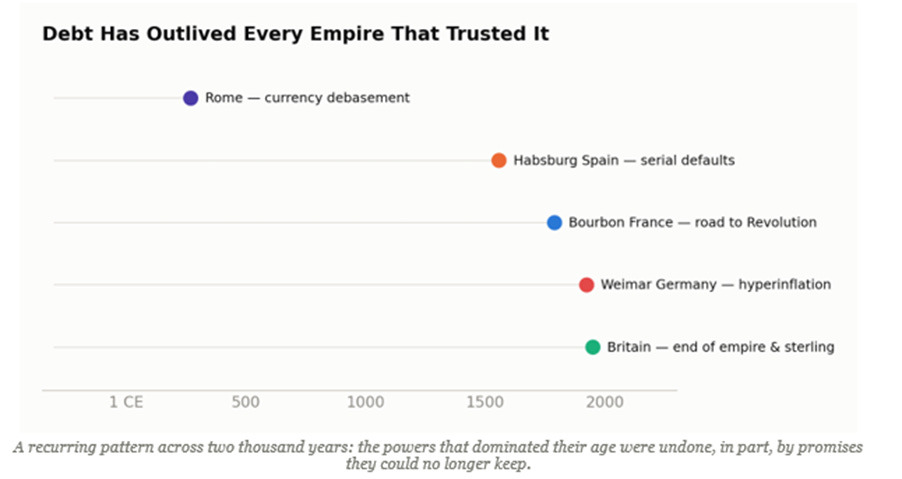
Rome didn’t sell bonds, but it had the classic problem: legions to pay, a bloated bureaucracy, and a capital full of citizens expecting free grain. Expenses up, revenue not so much. Rome’s clever fix was to quietly shave its currency. The silver denarius, nearly pure under Augustus, got clipped and cut so many times that by the third century it was basically a copper slug wearing a thin silver coat of paint. The result was one of history’s first great inflations: prices exploded, soldiers refused to be paid in shiny disappointment, and the trust holding the empire together evaporated. Debasement didn’t kill Rome by itself — but no empire outlives the moment people stop believing in its money.
Sixteenth-century Spain was the richest power in Europe, its vaults literally overflowing with New World silver. It also defaulted on its debts in 1557, 1560, 1575, 1596, and kept the streak alive well into the next century. The moral — and it’s one of the best in all of finance — is that no amount of income can outrun a spending problem. Spain’s fortune didn’t save it; it bankrolled exactly the endless holy wars that bankrupted it. The bankers who financed the party got wiped out too, and Spain’s golden century faded into a very long hangover.
No debt crisis has ever punched above its weight quite like eighteenth-century France’s. Decades of pricey wars — including, awkwardly, funding America’s revolution — left the crown spending over half its revenue just on interest. Reform was impossible, because the nobles who had money flatly refused to be taxed. Cornered, Louis XVI summoned the Estates-General in 1789 for the first time in 175 years, purely to scrounge up cash. That meeting turned into the French Revolution, the king turned into a cautionary tale via guillotine, and the revolutionaries who took over promptly printed their new currency, the assignat, straight into oblivion. Enter, eventually, a short man with big ambitions named Napoleon.
Buried under First World War reparations it couldn’t honestly pay, the Weimar Republic reached for the printing press with both hands. By late 1923 prices were doubling every few days, and Germans were hauling cash in wheelbarrows and burning banknotes for heat — the paper being worth more as kindling than as money. The middle class’s savings simply vanished, and the political fallout from a state that couldn’t protect its people’s money threads directly into the very dark decade that followed. Same recipe, again: couldn’t pay, wouldn’t default, printed instead — and the bill came due in something far worse than money.
Not every reckoning ends in guillotines or wheelbarrows. Britain came out of the Second World War victorious and quietly insolvent, its debt north of 250 per cent of output and its treasury on an American allowance. No drama, no default — just a slow, dignified decline: the empire wound down, the pound was devalued, sterling handed the reserve-currency crown to the dollar, and growth settled into a long shrug. It’s arguably the most useful case for today’s great powers, because it proves a debt crisis doesn’t have to be a bang. It can be a slow leak, narrated entirely in the soothing language of “adjustment” and “reform” — the kind of turning point historians only spot decades later, once everyone’s gone home.
It’s comforting to imagine a debt crisis as a tidy technical affair: a missed payment here, a downgrade there, a scary red line on a trading screen. But every one of those abstractions is really a fight over who goes without. The pensioner whose check gets frozen. The saver watching inflation quietly pick their pocket. The taxpayer asked to pay more for visibly less. The bondholder told to take forty cents and be grateful. The teacher, nurse, or soldier whose salary gets “reprioritized.” A debt crisis is, at bottom, a brawl over which of these people gets thrown overboard — and brawls like that have a nasty habit of climbing out of the finance ministry and into the street.

The usual road from debt to unrest is paved with austerity. A government that can no longer borrow freely — nudged either by its own math or by a bailout’s fine print — starts slashing spending and hiking taxes into an already sinking economy. Pensions trimmed, wages frozen, fuel and bread subsidies quietly withdrawn. To the bond market, this is “responsible fiscal adjustment.” To the citizen who suddenly can’t afford to heat the house or get to work, it’s a betrayal with a spreadsheet attached. The result is depressingly consistent: protests, strikes, and governments collapsing like folding chairs. Greece spent years in the streets after 2010 while its old political parties quietly imploded; the same script has run from Argentina to Sri Lanka, where a single subsidy cut was often just the match dropped on a very large pile of accumulated grievance.
Choose the printing press instead and the damage is quieter — at first — but no less corrosive. Inflation is the one tax that never went through a legislature, never appeared on a ballot, and never asked anyone’s permission. It hits hardest exactly the people least able to dodge it: those on fixed incomes, those whose pay checks trail prices, those whose modest savings sit politely in a bank account rather than in property or stocks. It quietly rewards debtors and mugs savers, pampers the asset-rich and fleeces the cash-poor. Bit by bit it dissolves the unspoken deal between a country and its people — the quaint idea that saving is smart and that money earned today will still buy something tomorrow. And when people stop believing that, they tend to stop believing a lot of other things too — which is precisely the sort of trust stable democracies are built on.

There’s also a darker link between going broke and going to war. A government staring down financial collapse and a furious public is a government with its back against the wall — and cornered governments have discovered, over and over, that nothing unites a squabbling population quite like a villain across the border. A war conveniently distracts from the mess at home, justifies emergency powers and a quiet pause on normal politics, and even doubles as economic “stimulus” a bankrupt treasury could never otherwise get away with. Financial historians have long noticed the grim rhyme between eras of monetary chaos and the outbreak of conflict. Debt doesn’t push the button on a war in any neat, mechanical way — it just supplies the gunpowder: the desperation, the rage, the frantic hunt for someone to blame. The financial crisis of the state and the political crisis of the nation are, far more often than we’d like to admit, the same crisis wearing two different hats.